Every brand is about to have a system. Not the good ones — all of them. This year you can type a company name into a box and have a logo, a palette, a type pairing, and a voice guide back in under a minute for the price of lunch. The same kits now ship as skills you install into an agent, so the system doesn't just exist, it gets applied to everything the agent makes without anyone asking. The logo, the type, the file you hand someone so they can keep going without you — that used to be the hard part of brand work. It's about to be the cheap part.
I know because I built a working version of how I design, so a founder or a PM could sit down with it when I wasn't in the room. I didn't do it to replace myself. I did it to find the moments I still had to be in.
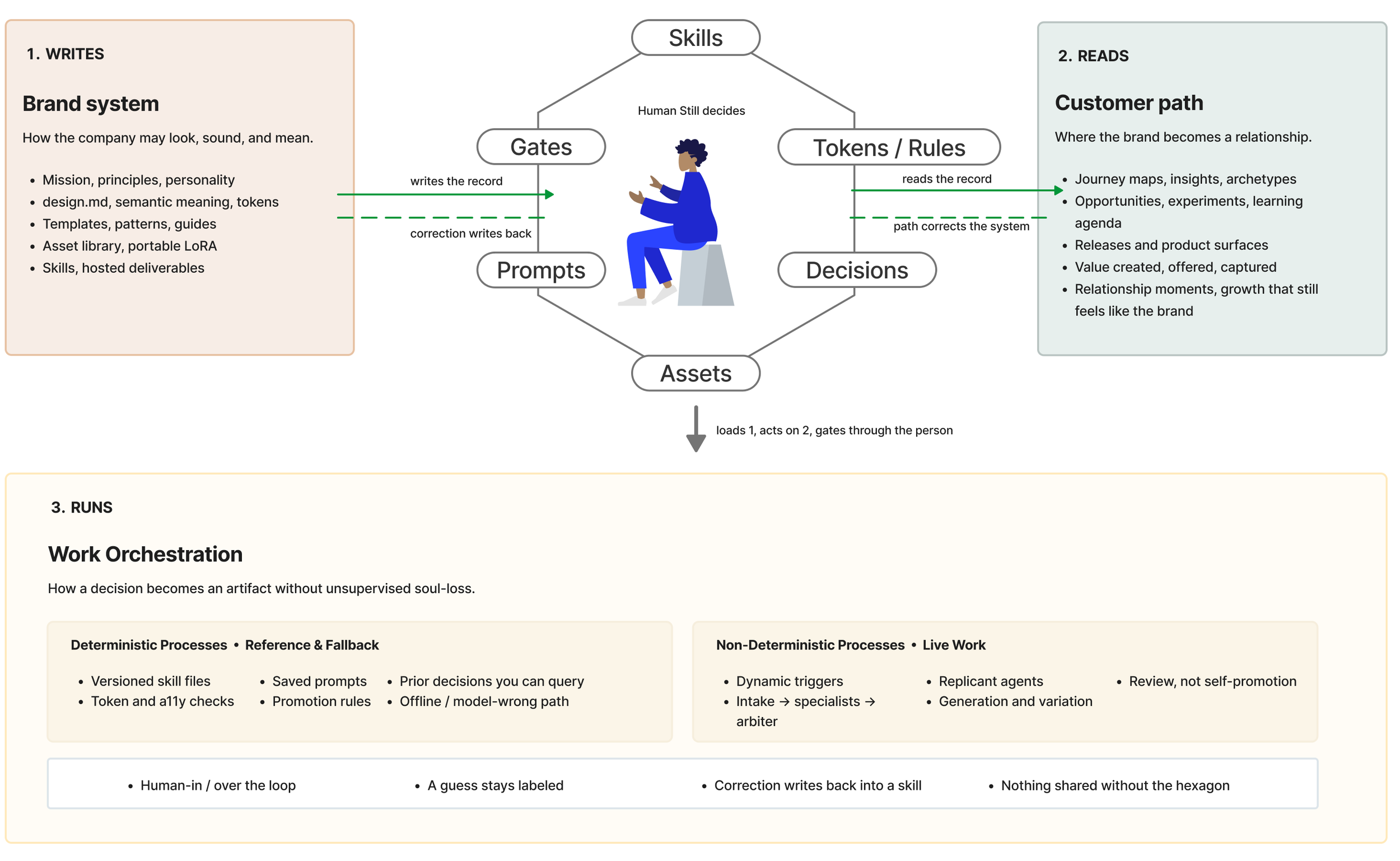
AIP – the creative platform I trained on myself
I assumed those moments would be large. Strategy. The platform. The whole architecture of a brand. And once the tools could finish a pass — once they could see where the work was going before I did — I expected to feel unnecessary.
What I felt instead was a quieter question. I've spent fifteen years as a product and brand designer, building the work and building the teams that build it. If the system can already draft everything, what am I still here for?
The answer wasn't mysterious. The tools could make something that looked finished, at dizzying speed. What I'm here for is to notice when finished is still wrong. Beautiful, even, and a little off — the kind of off you only hear if you already know how this company is supposed to talk to a person. That's the part that's still craft. Still taste.
That gap is the whole game now. Give the machine incredible inputs, a trained and harnessed system, a rationale that sounds airtight when it explains itself, and the output can still be undifferentiated. Rationally compelling, and not helpful to the person receiving it.
Sentiment is the new system. Not the score on a dashboard — the state of one person, in one hour, written down precisely enough that the machine can carry it into everything it makes. That's a system too, and a harder one than the logo ever was. But the machine can only carry it. It can't tell you whether what came out actually respected the person: whether it met them with taste, whether the quality was real, whether there was any delight in it or just the description of delight. That check is empathy, and empathy is the part I'm not willing to automate.
Where that noticing mattered most felt, at first, almost embarrassingly small. It didn't look like architecture. It looked like mail.
And mail, it turns out, runs on rules — plain ones, the kind a company writes down once and then has to mean every single time.
A customer shouldn't wait more than ten minutes to hear from a person. That sounds like a service rule. It's also the work hiding in plain sight. Someone is in the middle of their day. They need a recommendation that fits the hour they're in. A Thursday email that doesn't sound like it was written in January. A screen that asks them to update a card without making them feel scolded. A kickoff. A note after something worked. A postcard.
Those are the things you send. They're also how a brand stays in a relationship instead of becoming a kit.
Then there are the rooms people walk through to receive them — a website, an onboarding flow, a checkout confirmation. Bigger than a postcard, same job. Words, timed to someone else's day, that still sound like us.
That's what small means. Not that the work is trivial. That the part I still have to be in is this close to the ground: the next thing a person hears, and whether it sounds like the brand. Automate enough of that without a point of view and the brand doesn't get faster. It starts sending people away.
You can sketch the moment. You can pretend the logo doesn't exist. You cannot skip naming the moment in words. Urgent is not the same as new. Success is not the same as maintenance. Whoever is working with the machine still has to know which feeling the system is about to speak — or it will speak in a voice that is only almost right.
Principles are how you settle that. They end arguments — between people, and now between people and machines.
Here's one that came up while I was building. The system produced an email that was, by every measure it could check, correct. Right audience, right tone, a rationale for every line. It just had no brand in it. No mark, no attribution, nothing in the file that said who was speaking. The machine's case was reasonable: the copy carried the voice, the logo wasn't required, adding it was a design decision for later. I'd have lost that argument on the merits. I won it on a rule I'd already written down: nothing leaves this system brandless.
Every deliverable declares what it's wearing — the mark, a monogram, or a stated choice to wear nothing — and it declares it in the file, so the next person can see the decision was made rather than forgotten. The machine didn't push back. It didn't need convincing. It needed a principle to check against, and once it had one, the argument was over before it started.
That's the judgment I won't hand off. Everything else I built around it.
So the system starts with a conversation, not a tool. You tell it what you're here to make. It compiles the brief while you talk; you approve it, you never write it. It pulls the brand from the writing that already is the brand — the name, the purpose, the audience, the voice — and it won't produce anything brandless, ever. You make about four decisions. It does the rest. And what comes out is not a deck about a campaign. It's the email, ready to send, with the brand's fingerprints in the file.
I called it an Asset Intelligence Platform. I might call it Vault. I care more about the job than the name.
This is a way of working, not a trick. If we hand all of that judgment off, we won't just be replaced. We'll lose the language for the hard problems — the ones that only show up when a real person is in a real day, waiting to hear from you.
I tried replacing myself as a designer. What I'd actually built was another way to make the thing I was always making: a brand relationship, on time.