Email to Calendar Automation

Challenge

Important events and dates buried in emails were being missed. Manually scanning emails daily and adding calendar entries was time-consuming and error-prone. Early automation created too many false positives from newsletters and marketing emails.

📅 Solution

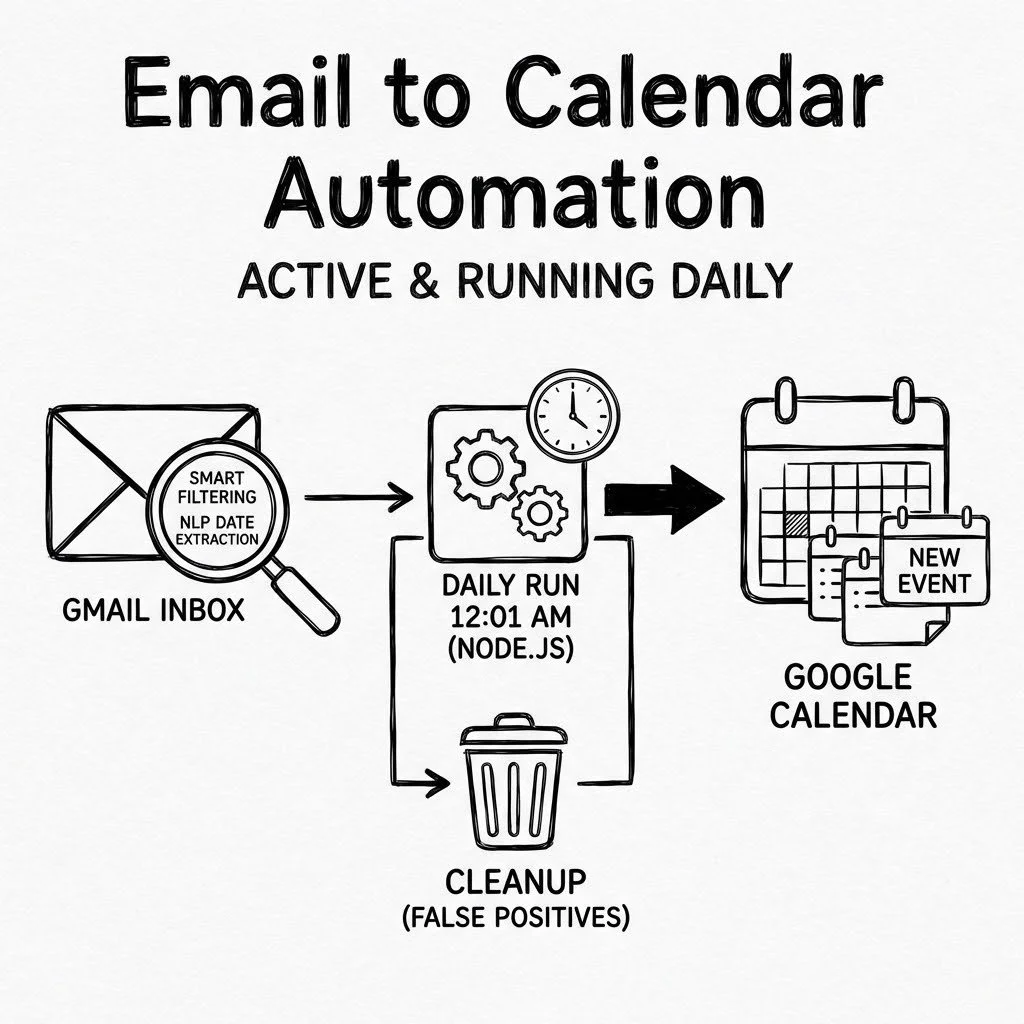
Built an automated workflow that intelligently scans emails and creates Google Calendar events:

- Service account authentication (no re-authorization needed)

- Smart filtering with EVENT_KEYWORDS and NON_EVENT_KEYWORDS arrays

- Scans gmail.com inbox

- Extracts dates from email text using natural language processing

- Creates calendar events automatically with duplicate detection

- Scheduled to run daily at 12:01 AM via cron job

- Cleanup script removed 150+ unhelpful "Event from email" entries
Tech Stack: Node.js, Google Calendar API, Google Gmail API

Status

⚡ **Active & Running Daily**

- Successfully processing emails nightly

- Smart filters prevent newsletter false positives

- Service account auth stable and reliable

Next Steps

- [x] Monitor for false positives/negatives

- [ ] Optional: Add email summary reports of events created

- [ ] Optional: Support for recurring events

- [ ] Optional: Calendar category/color coding by email source

- [ ] Future: Web dashboard to review/approve events before creation
Introducing Prompt Vault

Challenge

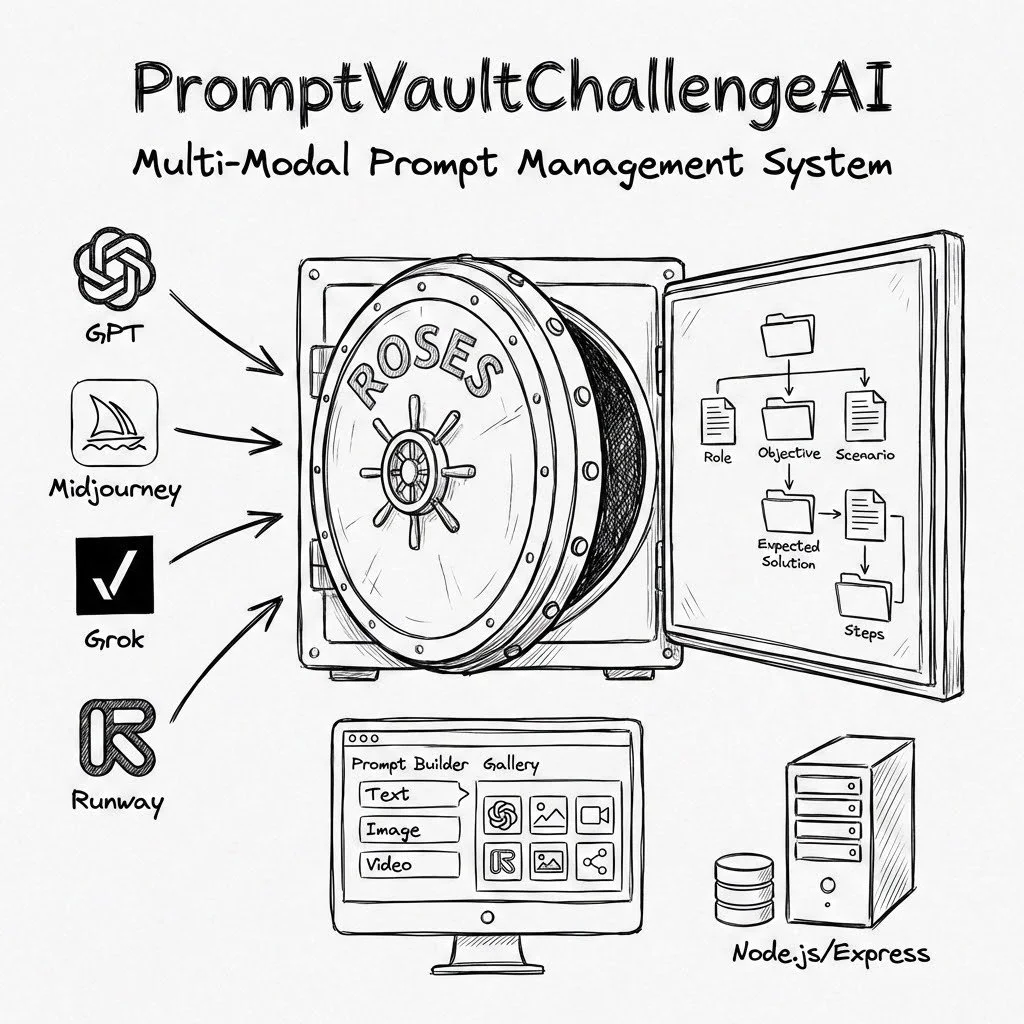
AI creators working across multiple platforms (GPT, Midjourney, Grok Imagine, Runway) needed a structured way to organize, version, and reuse prompts. Existing solutions were cloud-based, lacked multi-modal support, and didn't provide a framework for consistent prompt engineering.


🌹 Solution

Built a self-hosted, multi-modal prompt management system using the ROSES framework (Role, Objective, Scenario, Expected Solution, Steps). Features include:

- Adaptive prompt builders for Text, Image, and Video generation

- Type-specific fields (Style, Lighting, Camera Movement, etc.)

- Drag-and-drop gallery with live preview stitching

- Node.js/Express backend with JSON file database

- Built-in scratchpad, favorites, folders, tags, and search

- Import/Export with v1 format migration support

- Automatic backups and persistent storage

Tech Stack: HTML5, Tailwind CSS, Alpine.js, Node.js, Express

Status

✅ **Complete & Production-Ready**

- All core features implemented and tested

- Backend fully functional with CRUD API

- Documentation complete (README, Quick Start, Database Guide)

- GitHub prep files created (LICENSE, .gitignore, package.json metadata)

Next Steps

- [ ] Push to GitHub as open source project

- [ ] Create screenshots and demo GIF

- [ ] Optional: Deploy live demo on Vercel/Netlify

- [ ] Optional: Add Docker container for one-click deployment

- [ ] Future: SQLite option, multi-user support, prompt versioning

Open Claw vs. Nano Claw

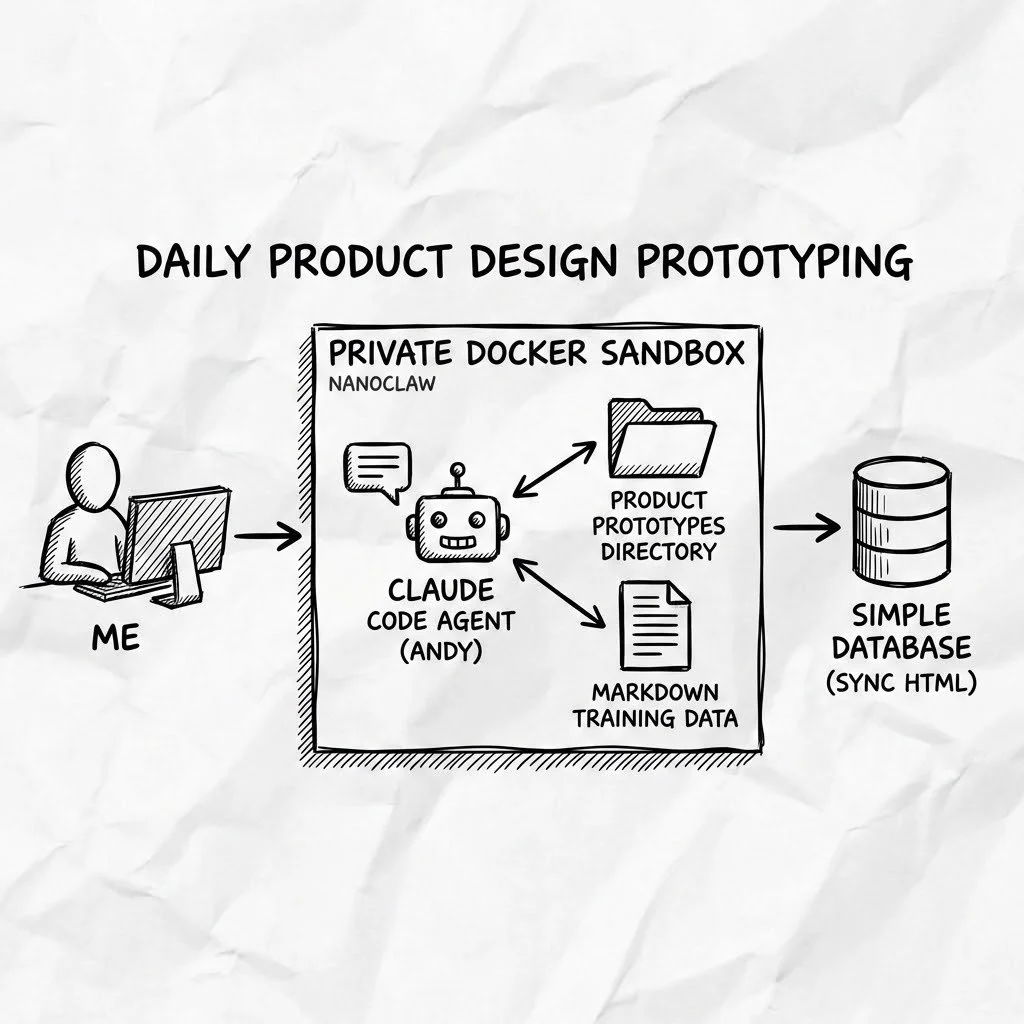
While I wasn't initially ready to embrace OpenClaw and grant full system access to activate and train my replicant, I opted for NanoClaw instead. As a lightweight version of OpenClaw, it allows me to create a private Docker container sandbox on my machine and use a chat client (WhatsApp) to interface with Claude Code. Working alongside my Claude Code agent, whom I've named ‘Andy’, I develop product design prototypes daily. My training data is stored in a markdown file, and all my product prototypes are kept in a dedicated directory. To ensure I don't lose my work during browser refreshes or similar issues, I also built a simple database to sync my HTML prototype data.

2020 reading roundup: adopt a test & learn mentality

As year 2020 comes to a close, and as I archive my day planner, mounds of sticky notes, and work journals for the year, I found a few quotes and insights I highly recommend to my community of UX professionals. Do you make it a practice to ask yourself how the next thing you design can maximize your opportunity to learn about your business, brand and users?

"Customer feedback is information you collect from your customers about their experience with your product, service, website, or business as a whole. You can use this feedback to improve customer experience by removing or reducing areas of friction and increasing positive touchpoints."

Hotjar's Understanding Customer Experience

"Expertise can be the gradual accumulation of many modest insights."

James Clear’s Blog | Author of Atomic Habits

"This generation has never been more informed than ever, but at the same time remarkably not reflective."

Unknown

"it’s critical to track the effects of your experiments both quantitatively and qualitatively”

“Whether we use KPI’s, Usability, Credibility, or other measures, having an imbalance in either direction leads to a lot of guessing.”

Business Thinking for Designers

“Always Have two goals when testing hypotheses…

The key to creating good product experiments is to start with two viability goals at once: a primary goal that changes and a secondary goal that stays the same. In other words, the primary goal is something the team wants to achieve without losing something else…

For example: Our (primary) goal is to increase revenue while keeping costs the same (secondary).”

Designing with Data

Bonus book recommendations

Make Time

  • Incredible collection of practical and easy productivity tactics to maximize the finite hours of your day. From the creators of GV's Sprint.

7 Habits of Highly Effective People

  • This 'old school' book is incredible for any working human. Having read it later in life I’ve realized it’s the clear foundation for many other popular business leadership and productivity books that followed it. This book is actually in my list of top 10 non-fiction books of all time. I officially understand what all the the hype is about following Franklin Covey and the years of success the organization has had helping professionals. I especially recommend this read to graduating High School or College students just coming in to the working world.

Review: Building a Story Brand by Donald Miller

I recently stumbled upon the Building a Story Brand book at an airport kiosk. After a quick skim I found the writing style refreshingly concise and compelling. Before the end of my flight I had read the entire book and discovered author Donald Miller’s equally interesting podcast and online course geared for busy marketing and sales professionals to clarify their brand’s message by framing their value proposition message around the age old Hollywood hero's journey story arc. 

Value proposition messaging

As an experienced designer day to day I totally agree with Miller's mantra that getting your brand message dialed is arguably the most important foundation underlying sales collateral design, especially marketing websites, and sales PDFs.

Note: this book does not cover the value prop canvas but is getting very clear on marketing sales pitch messaging, and design.

In essence, the book encourages the creative or business stakeholder (you) to orient your business’s offering to take your hand as the magical oracle guide to be lead to a new world of pain relief by way of a a predictable, outlined journey to win the day.

As we know as User Experience Designers, understanding our customer's pain point is an essential prerequisite to crafting compelling copy and content design. Once the headache type is understood, we can cleverly agitate that pain through psychological levers or inspiring motivation and present our brand as a trustworthy relationship that serves the resolution.

7 essential parts to every story brand

  • Main character

    • The customer, AKA the Hero trying to win the day

  • The Problem

    • The pain point you've identified in the customer to which your brand provides pain relief, wisdom, etc.

  • The Guide

    • The brand, the business, the service provided, the voice articulating the value proposition…(take my hand)

  • The Plan

    • A clear articulation of what your customer is expected to do with you (the brand) to achieve a mutually understood notion of success

  • Call to action

    • The action to take, such as contacting sales, submitting a web form, adding a product to a cart, checking out, and waiting for a package to arrive...

  • Stake if fail (loss)

    • The FOMO...agitating what life will likely continue to be without your product in their life

  • Stakes if succeed (win)

    • Reiteration of what success will look, feel, taste like, etc.

Exercise outline: creating value proposition website sections

  • A. The Header

    • i. Does it answer the questions: 

      • What are you offering?

      • How does it make our customers’ lives better?

      • Where can I buy it?

      • How can they buy it?

    • ii. Do the pictures you intend to use support the sales pitch or confuse customers about what you are selling?

  • B. The Stakes

    • i. What is life going to look like if the customer does not buy your product or service?

    • ii. What negative experiences are you keeping your customers from having to deal with?

  • C. The Value Proposition

    • i. What positive results will a customer receive if they buy your product?

    • ii. What does your customer’s life look like if they buy your product or service?

  • D. The Guide

    • i. Empathy: what empathetic statement can you make that expresses your care, concern, or understanding about your customer’s problem?

    • ii. Authority: how can you reassure your customers you are competent to solve their problem?

    • iii. Testimonials iv. Other: logos, statistics

  • E. The Plan

    • i. Three or four steps: What is the path a customer needs to take before or after buying your product?

    • ii. What are the benefits of each of those steps?

  • F. The Explanatory Paragraph

    • i. Simply use your one-liner* followed by your BrandScript script to make this section simple, clear, and easy.

  • G. The Video (optional)

    • i. Decide on video

    • ii. Decide on title

  • H. Price Choices (optional)

    • i. How will you visually display the price or prices of this product?

  • I. Junk Drawer

    • Misc. information, anything else you feel is compelling to say or include.

Buy the book!

The book is an excellent read and these highlights I found most interesting are no replacement for reading the full text. Purchase it here, and explore the podcast! I receive no kickback for sales proceeds, I’m simply advocating UX Designers and my readers consider this cool shot in the arm book for better understanding marketing experience design.