
For six months I’ve been circling a question our industry still treats as optional: how do we capture the expertise behind great creative work — not just generate assets faster?
The Asset Intelligence Platform is my answer. Start from the job to be done. Model the judgment the job actually requires. Only then generate the assets. Everything else is downstream.
The question under the tools
Information is abundant. Expert judgment is rare.
Nearly every AI creative tool shipping today makes the abundant thing more abundant — more logos, more heroes, more copy, faster. Almost none of them touch the scarce thing: the mental models, the tradeoffs, the taste, and the failure patterns that decide whether any of that output is actually right.
I’ve spent almost twenty years as a product designer working at the brand–product intersection, including a multi-year visual brand refresh at Zillow scale. Over the past six months I shipped a stack of working products with AI as my pair: a founder brand-intake tool with hundreds of commits, an illustration-system builder that trains a LoRA on one illustrator’s hand, a prompt library with a Chrome extension that rides shotgun in any text field. Each one embodied real creative judgment. The problem was that the judgment still lived in my head and in scattered docs. Every new product started from a blank page.
AIP is where that judgment becomes infrastructure. Its founding move is simple and non-negotiable: start from the job to be done, never the asset type. A logo, a brand guide, a website hero — these aren’t the product. They’re compiled expressions of intent, context, capabilities, decisions, and evaluation criteria. Model that chain explicitly and the asset stops being the point. The judgment is the point. The asset is what it compiles to.
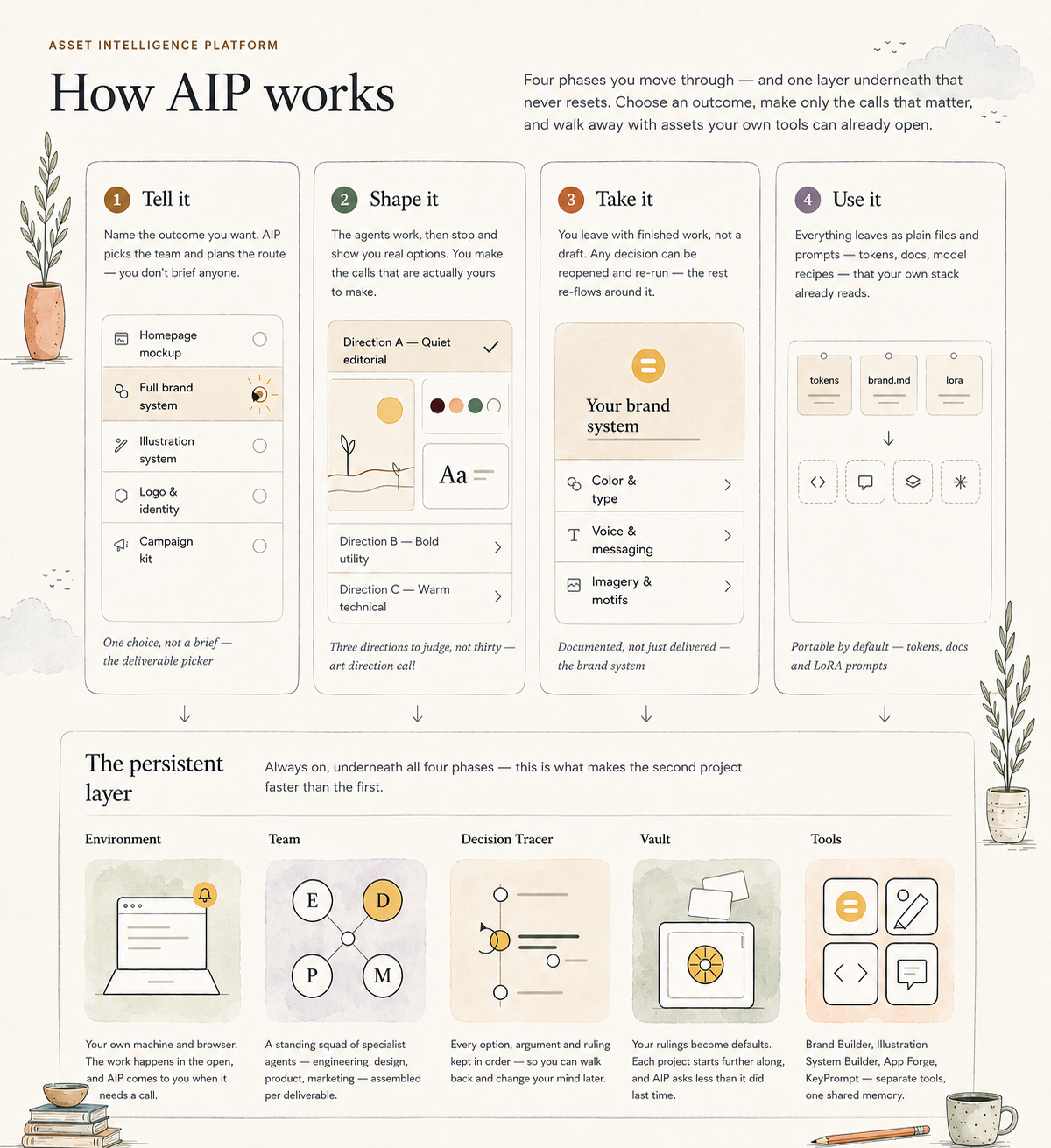
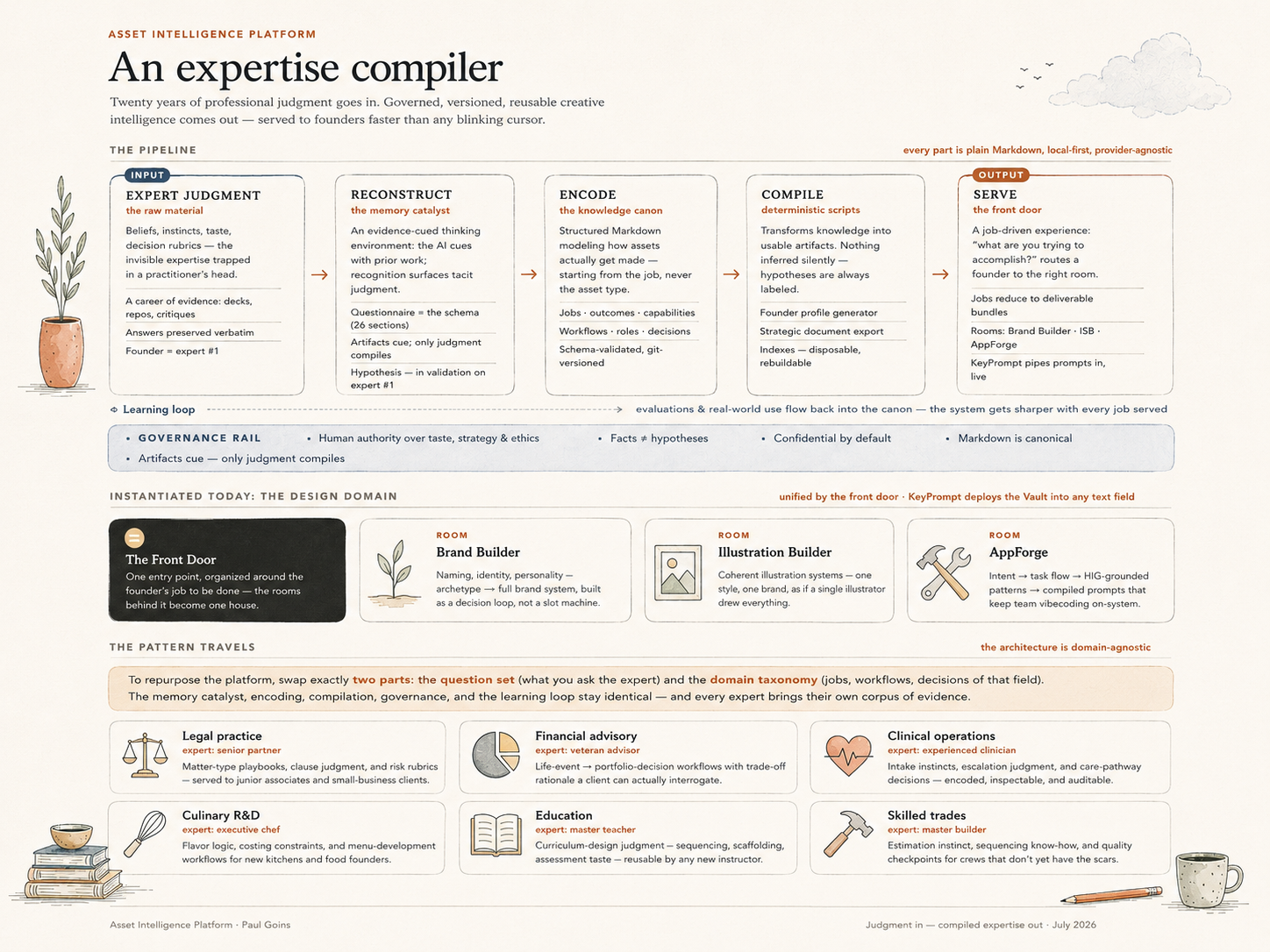
The portfolio as a stack — Brand Builder, Illustration System Builder, AppForge, PromptVault/KeyPrompt as surfaces on top; AIP as the shared knowledge layer beneath them; gateway and contracts as the connective tissue.
Trained on its founder first
Under the hood, AIP is deliberately unglamorous: a version-controlled repo of plain Markdown with YAML frontmatter, validated by schemas and scripts. Jobs, outcomes, capabilities, assets, workflows, roles, decisions — all cross-referenced, diffable, and provider-agnostic.
Two rules give it its character.
1. Every fact is separated from every hypothesis. Anything the system infers stays flagged as a guess until a human ratifies it.
2. A human keeps authority over strategy, meaning, and taste — by doctrine, not as an afterthought.
Before the platform hardened into software, it got trained on me. I answered all twenty-six sections of its Founder Foundation questionnaire — five hundred-plus answers, as much of my own working brain as I could get onto the page — and compiled the result into twenty-six structured knowledge files. That capture taught me the platform’s most important lesson: you cannot download your own expertise. Judgment doesn’t surface on demand. It surfaces in response to cues — old work, contradictions, a diagram that gets your idea slightly wrong. So the capture instrument evolved from a straight interview into an evidence-cued thinking environment. Expertise is reconstructed, not retrieved.
The front door compiles the brief
A founder arrives wanting a deliverable — a homepage, a brand system, an illustration style, a logo. The front door’s job is not to collect a brief. It is to compile one, in three beats.
The opening question is never “tell us about your company.” It’s “what do you want to walk away with?” Each choice silently resolves to a route through the platform’s rooms. The founder never sees the plumbing.
Then a short guided conversation — five questions at most — compiles the governing document live and in view: outcome, route, audience, hard rules, weights. The PRD is an output of the front door, not an input to it.
Finally, before anything runs, the founder sees the gate map: the whole journey with their decision moments flagged. “You’ll make about four decisions. We do everything else.” Ratifying the brief is Gate 0. Nothing advances past a gate without them.
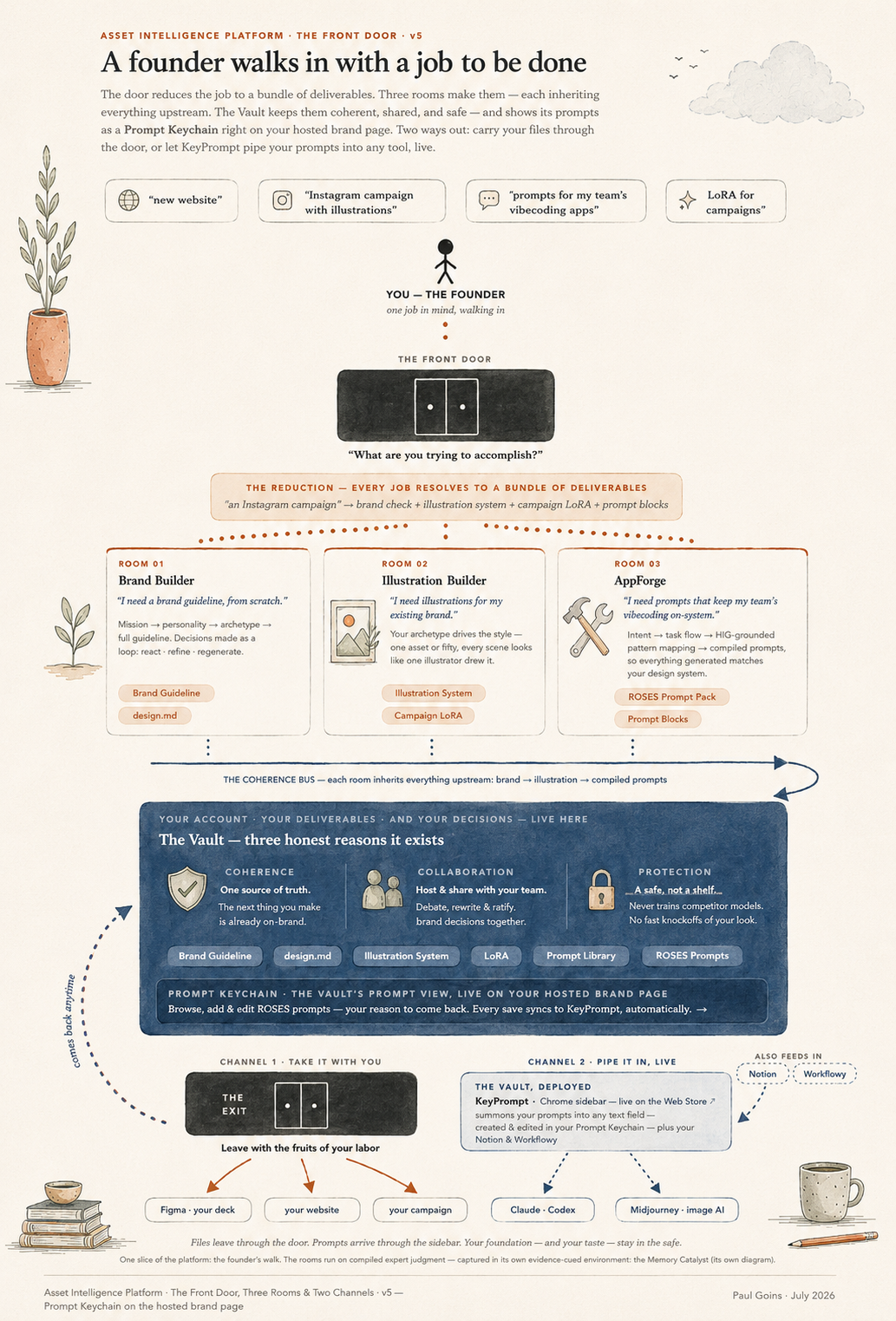
Three beats to a governed run. Deliverable-first entry → the brief compiling live beside the conversation → the gate map shown as a contract.
Designed for one human. The swarm is optional
This is the part I want to be precise about, because it’s where the platform diverges from the current agent-mania.
AIP is built first and foremost as a human-in-the-loop experience. You can walk the entire flow yourself — intake, Brand Builder, the rest of the tools — with no agents at all. The interface is designed so a single founder can make every decision, iterate on stylescapes and concepts, and leave with a clean set of deliverables. The designed experience stays paramount.
If you prefer, you can activate a custom agent squad: Product, Design, Engineering, and Marketing specialists, plus a Decision Arbiter — or any smaller mix. The intake fans out to the four specialist reads. The arbiter distills their debate into a single proposal and, by doctrine, never self-approves. Between gates the agents handle the busywork inside the tools. At the flagged moments a decision card arrives: the question in plain language, each discipline’s position, the weights at stake, and five clear levers — approve, approve the alternate, approve with modification, reject with guidance, or pause.
The arbiter frames the debate. The founder rules. Every ruling is logged to a decision trail and trains better defaults, so the platform asks less on every subsequent visit.
The squad is still experimental, and I think that honesty is a feature. But the first live run already validated the shape: a single approve-with-modification through a gate card produced the best artifact of the entire run. The system drafts. The human ratifies. Nothing auto-ships.
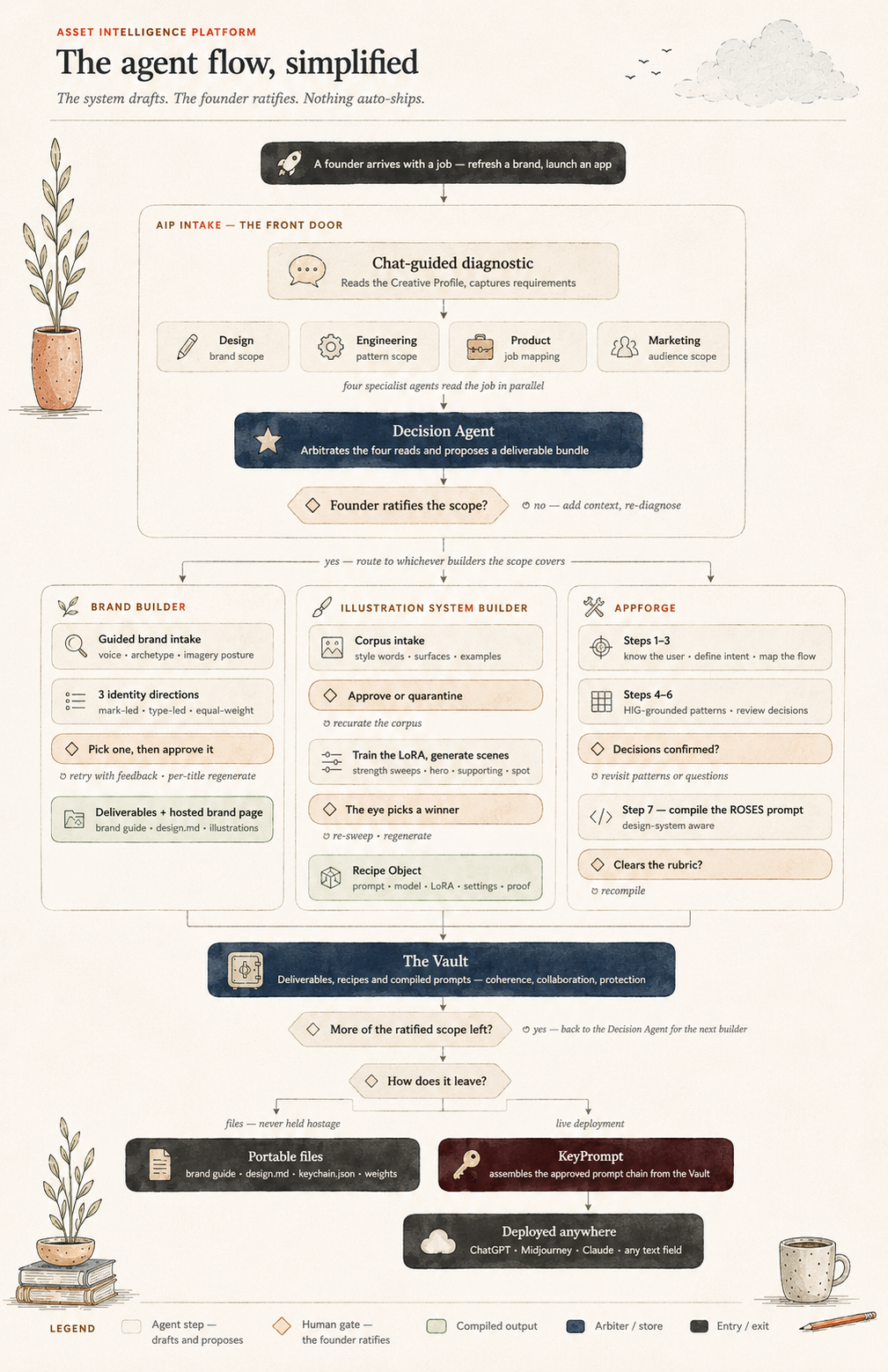
The agent flow, gates and all. Intake fanning out to the four specialists, the Decision Agent proposing, the founder’s diamond-shaped gates at every ratification point, routes through the three builders, convergence in the Vault.
The rooms, and the contracts between them
The platform routes work into rooms that already exist as standalone products — one gateway, many doors, never a merged mega-app.
Brand Builder walks a founder from a three-minute conversation to a complete starter brand and a design.md that hands off cleanly to any downstream tool.
Illustration System Builder turns one illustrator’s hand into a governed system — constitution, skins, rulebook, calibrated captions, trained weights.
AppForge interrogates a builder’s intent and compiles a design-system-aware prompt for whatever coding tool they already love.
KeyPrompt store validated prompts and deliver them at the point of use.
What makes these one platform rather than a folder of apps is a pair of small, explicit contracts.
The Recipe Object (in production today) says a saved prompt is never bare text. It is the compiled prompt plus model, LoRA reference, validated settings, and a proof image — because provenance is half the quality.
The Creative Profile (specified, next to build) is the running record of everything any room has learned about a user, so every intake reads it first and asks only what’s missing. That’s the mechanism that makes knowledge compound instead of scatter.
The signature move repeats in every room: stop short of generating the final artifact. Hand over compiled judgment in portable form. These tools never compete with generation tools. They govern what goes into them.
The exit is the point
Everything a run produces — briefs, decision logs, prompts, recipes, LoRA links — lands in a hosted page you can download or keep living in Google Drive, where you and the agents can also pull reference images straight into the flow.
And the files are never held hostage. The brand guide, the design.md, the keychain.json, your trained weights — all portable, all yours to run anywhere. Then you hop over to Figma or Adobe with a coherent, production-ready starting point instead of a blank canvas.
I call the custody position open with gravity. The water is free — you own the weights. The reason you come back is the fountain: a generation experience plumbed into your system, your rulings auto-appended, your history remembered. Retention through novel value, never through capture.
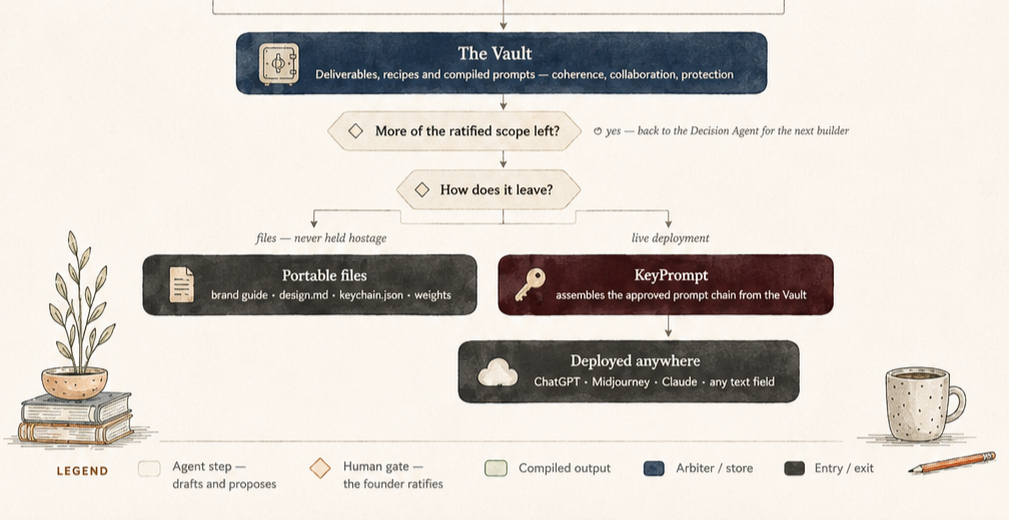
What leaves, and where it goes. The Vault converging the rooms’ outputs, then splitting to the two exits: portable files (brand guide, design.md, keychain.json, weights) and live deployment through KeyPrompt into any text field on the web.
What this means beyond one platform
I'll name what's proven and what isn't.
Built and live: the products, the knowledge base, the questionnaire, the Recipe Object.
Mapped and validated in a first run: the front door and the gate cards.
Experimental: the agent squad.
Untested: capturing an expert who isn’t me. Expert #2 is the real test of everything.
The bet underneath is bigger than my portfolio. The tools that extract and encode expertise don’t replace experts — they extend their reach. The senior designer stops being the person who answers the thousandth instance of the same question and becomes the person who writes the system that answers it.
That’s the framework I’m really bringing: a way for organizations to encode their best creative thinking into systems that compound — inspectable, versioned, and governed by the humans whose judgment they carry.
Assets are downstream of judgment. Make the judgment explicit first, and everything you make after starts from a full page.
I'm a product designer who ships. If your team is figuring out what AI means for creative work — or you want a demo of any of this — I'd love to talk: info@paulgoins.com · paulgoins.com