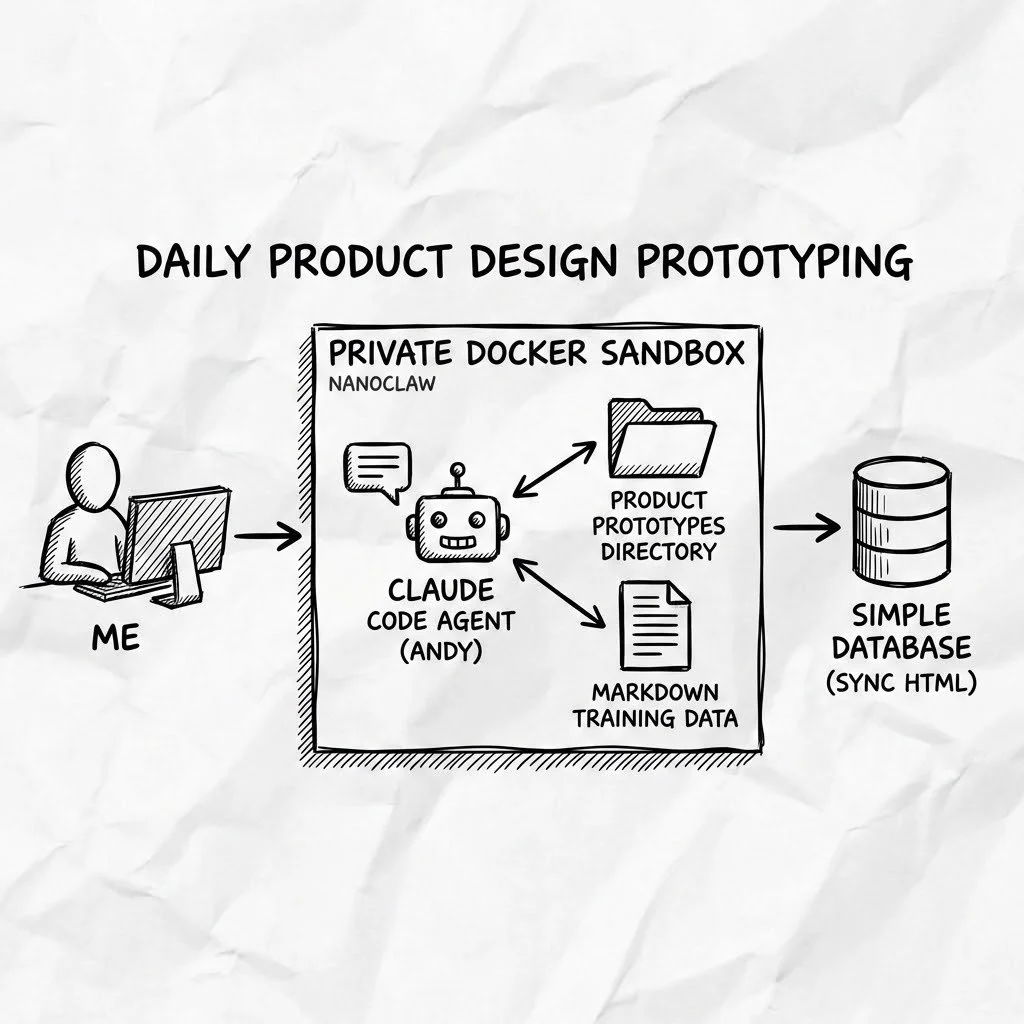
While I wasn't initially ready to embrace OpenClaw and grant full system access to activate and train my replicant, I opted for NanoClaw instead. As a lightweight version of OpenClaw, it allows me to create a private Docker container sandbox on my machine and use a chat client (WhatsApp) to interface with Claude Code. Working alongside my Claude Code agent, whom I've named ‘Andy’, I develop product design prototypes daily. My training data is stored in a markdown file, and all my product prototypes are kept in a dedicated directory. To ensure I don't lose my work during browser refreshes or similar issues, I also built a simple database to sync my HTML prototype data.
2020 reading roundup: adopt a test & learn mentality
As year 2020 comes to a close, and as I archive my day planner, mounds of sticky notes, and work journals for the year, I found a few quotes and insights I highly recommend to my community of UX professionals. Do you make it a practice to ask yourself how the next thing you design can maximize your opportunity to learn about your business, brand and users?
"Customer feedback is information you collect from your customers about their experience with your product, service, website, or business as a whole. You can use this feedback to improve customer experience by removing or reducing areas of friction and increasing positive touchpoints."
"Expertise can be the gradual accumulation of many modest insights."
James Clear’s Blog | Author of Atomic Habits
"This generation has never been more informed than ever, but at the same time remarkably not reflective."
Unknown
"it’s critical to track the effects of your experiments both quantitatively and qualitatively”
“Whether we use KPI’s, Usability, Credibility, or other measures, having an imbalance in either direction leads to a lot of guessing.”
“Always Have two goals when testing hypotheses…
The key to creating good product experiments is to start with two viability goals at once: a primary goal that changes and a secondary goal that stays the same. In other words, the primary goal is something the team wants to achieve without losing something else…
For example: Our (primary) goal is to increase revenue while keeping costs the same (secondary).”
Bonus book recommendations
Incredible collection of practical and easy productivity tactics to maximize the finite hours of your day. From the creators of GV's Sprint.
7 Habits of Highly Effective People
This 'old school' book is incredible for any working human. Having read it later in life I’ve realized it’s the clear foundation for many other popular business leadership and productivity books that followed it. This book is actually in my list of top 10 non-fiction books of all time. I officially understand what all the the hype is about following Franklin Covey and the years of success the organization has had helping professionals. I especially recommend this read to graduating High School or College students just coming in to the working world.
Review: Building a Story Brand by Donald Miller
I recently stumbled upon the Building a Story Brand book at an airport kiosk. After a quick skim I found the writing style refreshingly concise and compelling. Before the end of my flight I had read the entire book and discovered author Donald Miller’s equally interesting podcast and online course geared for busy marketing and sales professionals to clarify their brand’s message by framing their value proposition message around the age old Hollywood hero's journey story arc.
Value proposition messaging
As an experienced designer day to day I totally agree with Miller's mantra that getting your brand message dialed is arguably the most important foundation underlying sales collateral design, especially marketing websites, and sales PDFs.
Note: this book does not cover the value prop canvas but is getting very clear on marketing sales pitch messaging, and design.
In essence, the book encourages the creative or business stakeholder (you) to orient your business’s offering to take your hand as the magical oracle guide to be lead to a new world of pain relief by way of a a predictable, outlined journey to win the day.
As we know as User Experience Designers, understanding our customer's pain point is an essential prerequisite to crafting compelling copy and content design. Once the headache type is understood, we can cleverly agitate that pain through psychological levers or inspiring motivation and present our brand as a trustworthy relationship that serves the resolution.
7 essential parts to every story brand
Main character
The customer, AKA the Hero trying to win the day
The Problem
The pain point you've identified in the customer to which your brand provides pain relief, wisdom, etc.
The Guide
The brand, the business, the service provided, the voice articulating the value proposition…(take my hand)
The Plan
A clear articulation of what your customer is expected to do with you (the brand) to achieve a mutually understood notion of success
Call to action
The action to take, such as contacting sales, submitting a web form, adding a product to a cart, checking out, and waiting for a package to arrive...
Stake if fail (loss)
The FOMO...agitating what life will likely continue to be without your product in their life
Stakes if succeed (win)
Reiteration of what success will look, feel, taste like, etc.
Exercise outline: creating value proposition website sections
A. The Header
i. Does it answer the questions:
What are you offering?
How does it make our customers’ lives better?
Where can I buy it?
How can they buy it?
ii. Do the pictures you intend to use support the sales pitch or confuse customers about what you are selling?
B. The Stakes
i. What is life going to look like if the customer does not buy your product or service?
ii. What negative experiences are you keeping your customers from having to deal with?
C. The Value Proposition
i. What positive results will a customer receive if they buy your product?
ii. What does your customer’s life look like if they buy your product or service?
D. The Guide
i. Empathy: what empathetic statement can you make that expresses your care, concern, or understanding about your customer’s problem?
ii. Authority: how can you reassure your customers you are competent to solve their problem?
iii. Testimonials iv. Other: logos, statistics
E. The Plan
i. Three or four steps: What is the path a customer needs to take before or after buying your product?
ii. What are the benefits of each of those steps?
F. The Explanatory Paragraph
i. Simply use your one-liner* followed by your BrandScript script to make this section simple, clear, and easy.
G. The Video (optional)
i. Decide on video
ii. Decide on title
H. Price Choices (optional)
i. How will you visually display the price or prices of this product?
I. Junk Drawer
Misc. information, anything else you feel is compelling to say or include.
Buy the book!
The book is an excellent read and these highlights I found most interesting are no replacement for reading the full text. Purchase it here, and explore the podcast! I receive no kickback for sales proceeds, I’m simply advocating UX Designers and my readers consider this cool shot in the arm book for better understanding marketing experience design.
Dare to Lead by Brené Brown
Every so often I spend some time organizing personal files and run across an interesting note I’ve captured reading a book or article. I found these few bullet points I had jotted down while going through Dare to Lead that I found so useful, and surprisingly pertinent to my career as a UX Design Leader. Highly recommend this book, it’s worth the time for any young professional looking to lead people effectively.
Key takeaways:
What stands in the way, becomes the way.
Don’t avoid tough conversations putting politeness over clarity.
Focus more on scary feelings that arise with change.
Don’t focus on problematic behaviors.
Connection & empathy builds trust.
Embrace failures and risks.
Focus more time on fixing what broke, not on reassuring people–they are ‘still’ valuable.
Focus on accountability & learning, not shame & blame.
Stay dedicated to problem identification.
Don’t rush to big blind swings.
Be measurable.
Strive for progress not perfectionism.
10 Awesome UX Design Podcasts
If you are new to Podcasts or have already discovered this amazing technology for design literacy already.
I’ll admit there are a large number of podcast episodes framed to showcase content authors on a book tour, but the nuances of communication unlocked by longer conversations surface some often greater insights beyond the usual scope of Tweets, Medium articles, and books. I strongly recommend you give the following shows a try if you’re interested in the conversation surrounding UX/UI Design and business.
High Resolution
Design thinking and product design discussions with design and business leaders.
UI Breakfast
Practical interview with cutting edge and inspiring designers, developers, researchers and business leaders. Great way of finding inspiring work, products and workflows from talented people.
Design Matters
Debbie Millman asks industry leaders smart questions about their process, workflow, and experience.
User Defenders
The host teases our great stories from epic designer guests. Production quality and use of time are both impressive.
Method Podcast
Huge variety of design topics covered by Google in this podcast. Great way to stay up to date with the most cutting edge best practices and perspectives in design today.
DesignBetter.co Podcast
Cool conversations with design and business leaders with emphasis on organization and leadership concepts.
A Responsive Web Design Podcast
Karen McGrane and Ethan Marcotte get into project workflow details and valuable lessons learned following impressive responsive website redesign projects. Bummer this podcast had to end–some great insight especially regarding content strategy and design system interplay.
O’Reilly Design Podcast
Always relevant and future thinking interviews and Q&A with cutting edge designers. Good way to find new inspiring people to follow.
Invision Design Talks (YouTube)
Super relevant discussions from Invision whose content (like their products) is always well thought and a great use of time. Audio versions of these talks are available through some podcast apps.