Role: Founder, Designer & Full-Stack Builder (Solo)
Timeline: 2026 (4 months, evenings & weekends)
Collaborators: None — solo across product design, prompt engineering, and full-stack engineering
Deliverables: AI-Native Brand System, Prompt-Engineering Architecture (SKILL.md Library), Full-Stack Product
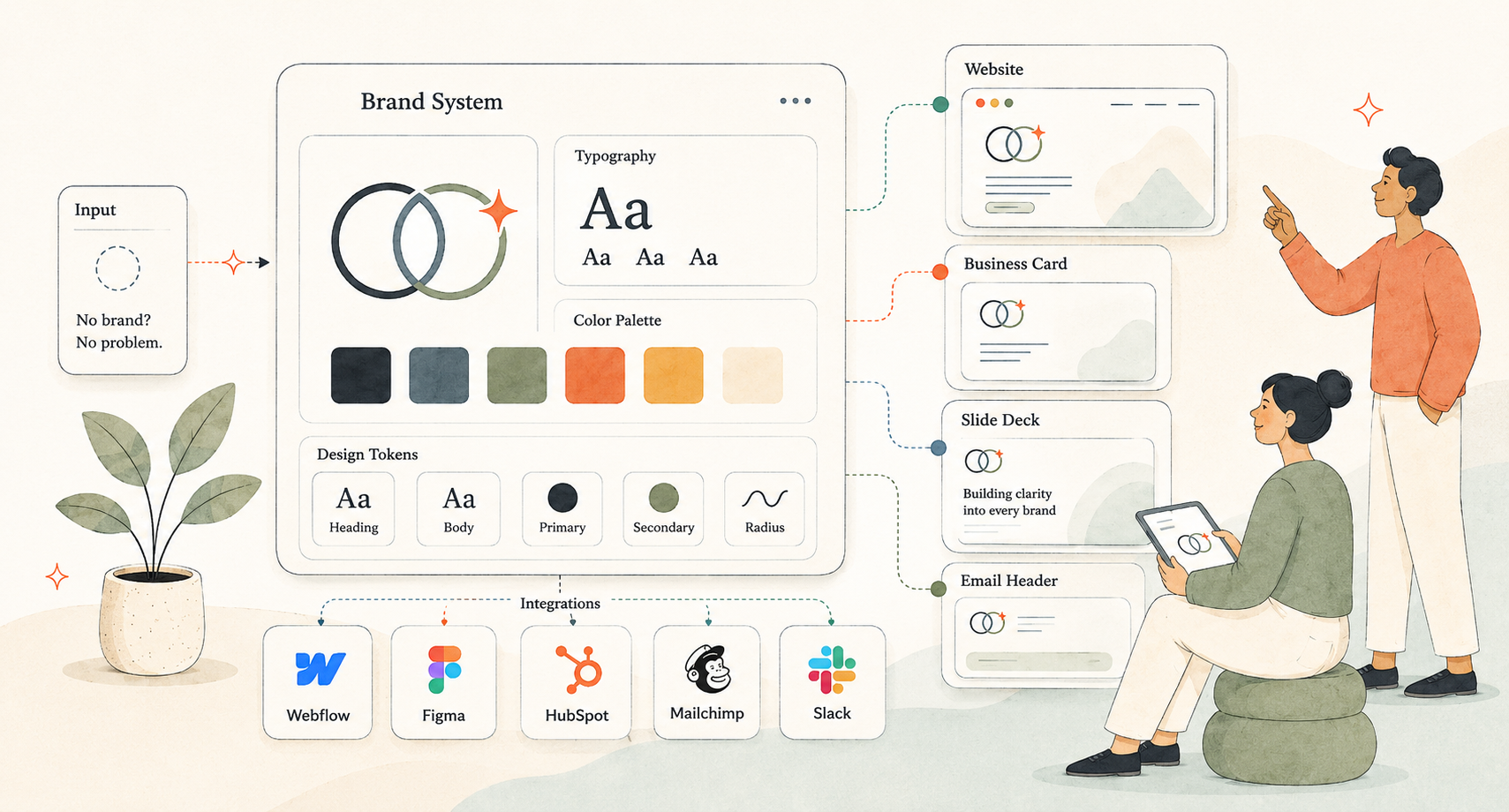
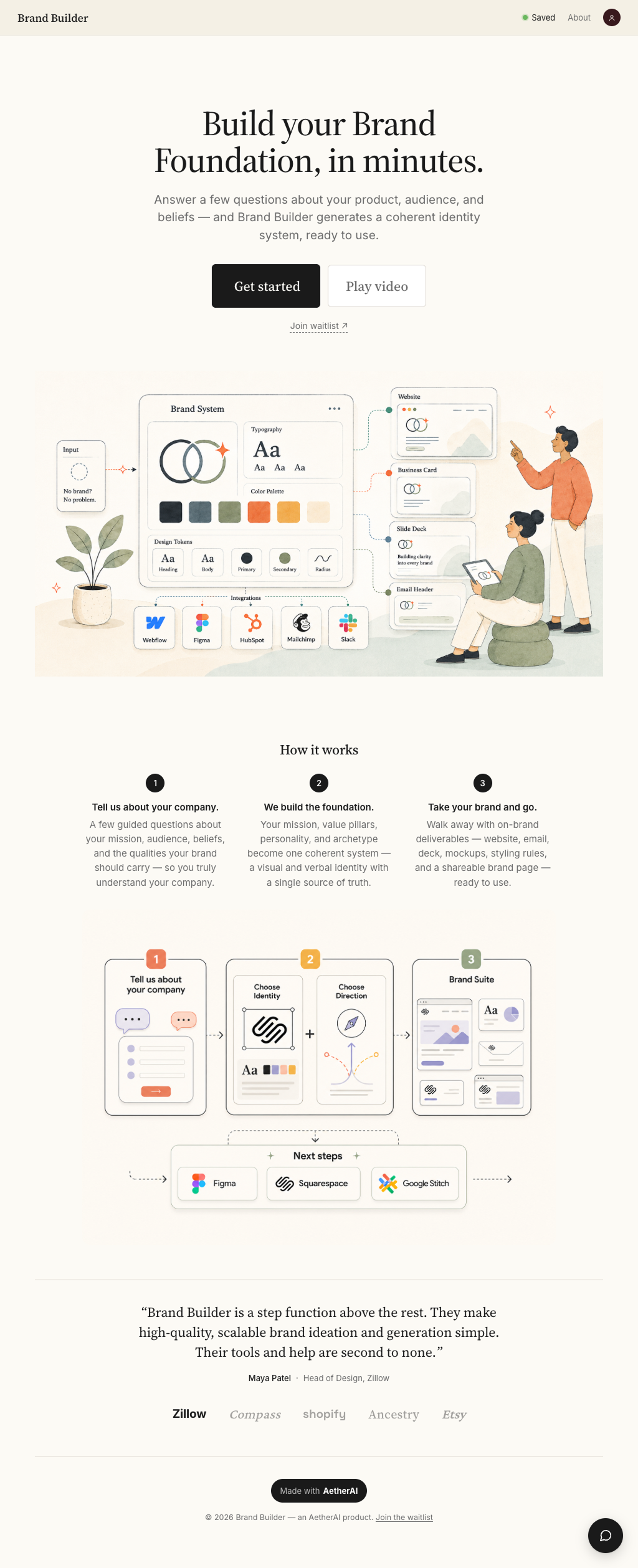
Founders describe their brand in a natural-language chat and leave thirty minutes later with a complete identity system — palette, typography, moodboard, marketing website, product UI, email templates, illustrations, and a shareable brand foundations doc.
User & problem
Who it's for Pre-seed and seed founders — about 500,000 in the US every year — need a credible brand foundation to fundraise, hire, and ship. They have taste, a pitch, and no time.
What they hit today Their options are a $30–80K agency engagement they can't justify pre-money, or a DIY logo generator that produces something so shallow or generic they're embarrassed to use it. Neither serves them.
But the harder problem sits underneath.
Founders now build fast into a dozen digital territories at once — marketing site, product UI, mobile app, onboarding email, pitch deck, social. Each surface exercises different mental models: interaction, imagery, voice. Without a coherent backbone — a who this company is they can defend — they get stuck at two extremes. Either blocked, because every micro-decision requires a fresh judgment call. Or running blind, moving fast and shipping inconsistency that quietly sends their audience to a competitor who feels more considered.
And here's the harder truth: even founders who do know their strategy — who can name their mission, their audience, their category positioning — often can't translate that clarity into a distinct visual and verbal identity. Knowing you want "editorial calm" is different from knowing that means a humanist serif, a restrained accent color, illustration that leans away from studio polish, and copy that trusts the reader. That translation is the actual expertise — what senior brand designers spend fifteen years learning to do fluently. It's exactly what Brand Builder encodes.
And the market pressure is real. Everyone is a product builder now. App-to-app similarity is becoming communicable — the gap between "looks like a startup" and "feels like ITSELF" is closing fast. Standing out is harder than it's ever been, and founders who can't move from strategy to distinct visual and verbal identity keep landing on the wrong side of that gap.
What they actually need Thirty focused minutes with a system that respects their judgment, understands their category, and produces something specific enough to defend in a pitch meeting. Not templated. Not generic. Rooted in a strategic frame they can talk about — because every downstream decision (which feature to ship, what to put on the home page, how to write the empty state) is more coherent when the brand is.
And beyond a static asset, they need a shared language — words and structural concepts that link brand strategy directly to visual and verbal identity, so a founder and a cofounder can be talking about the same brand in the same terms when they're arguing about the third empty state.
Walkthrough
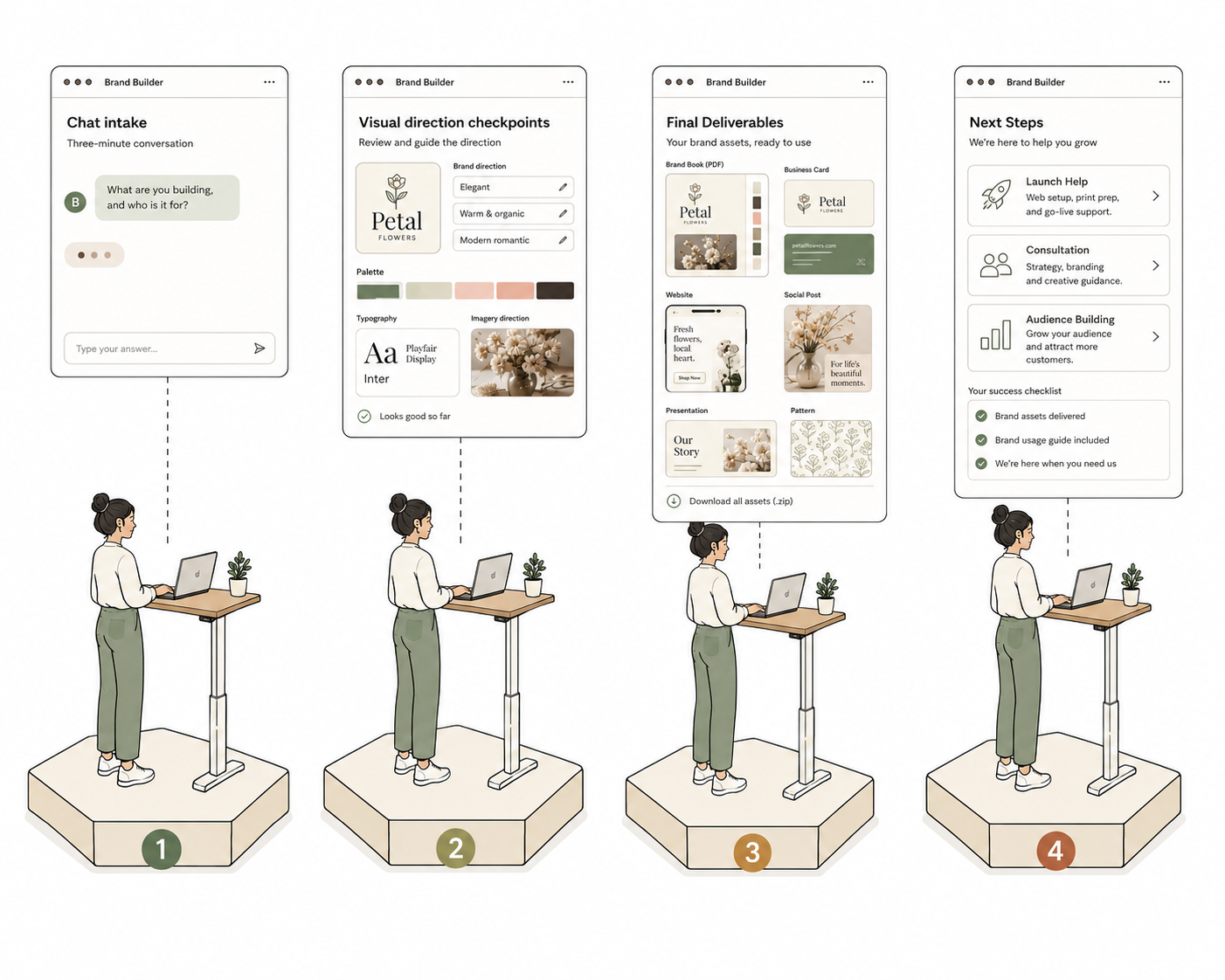
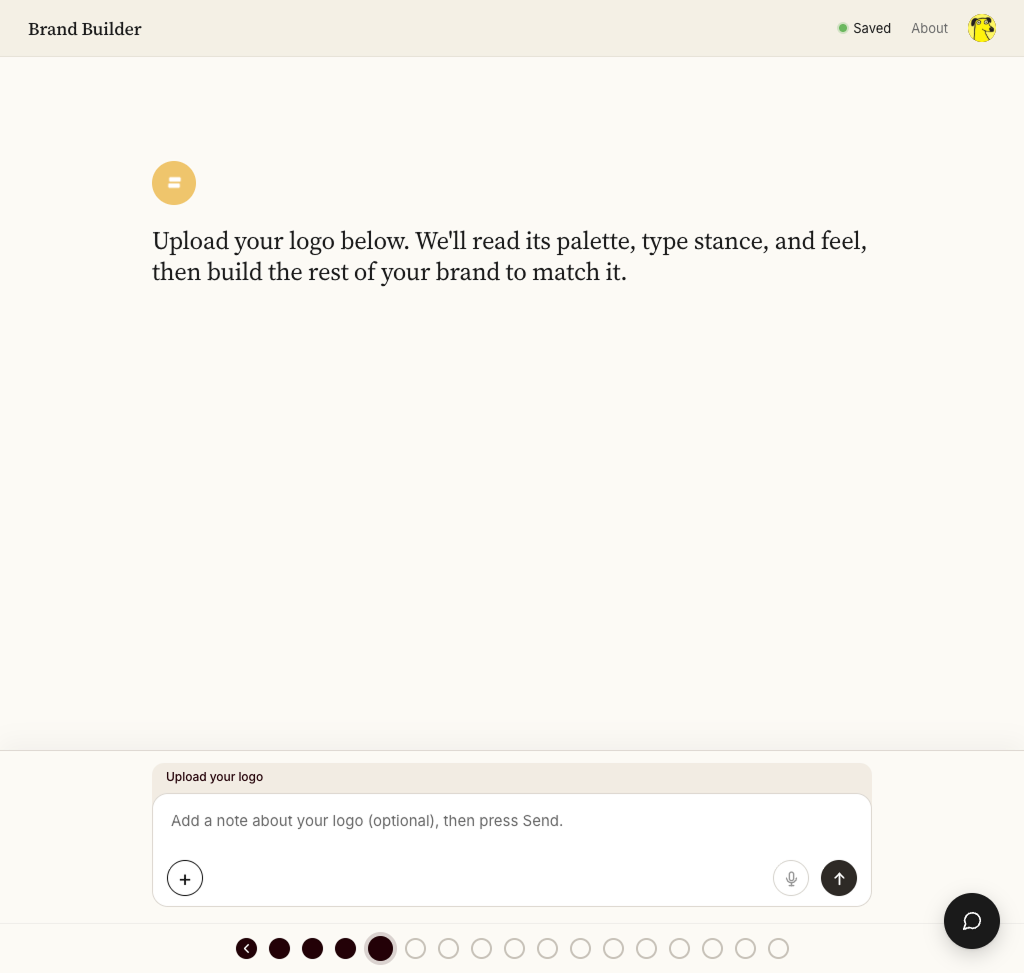
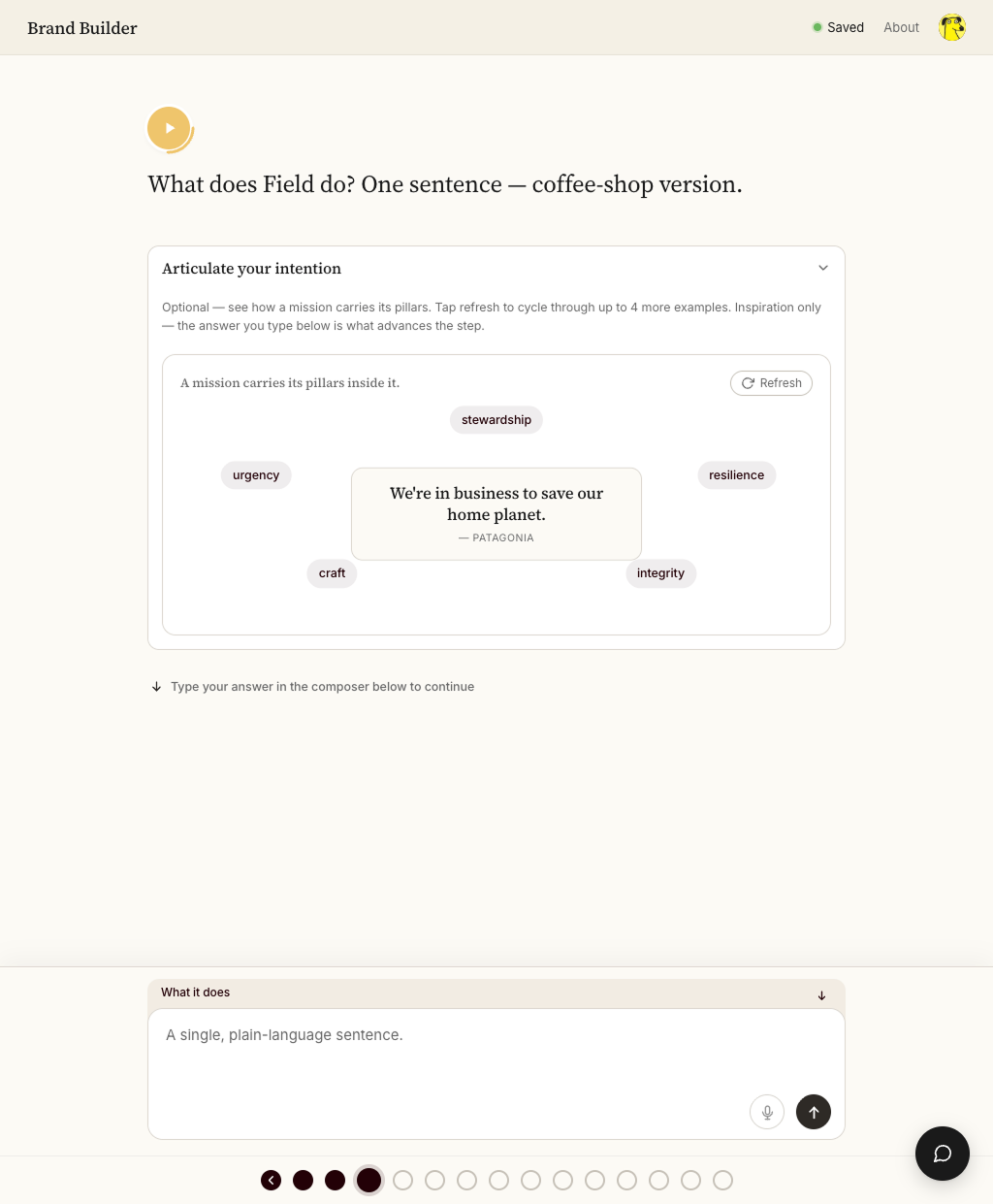
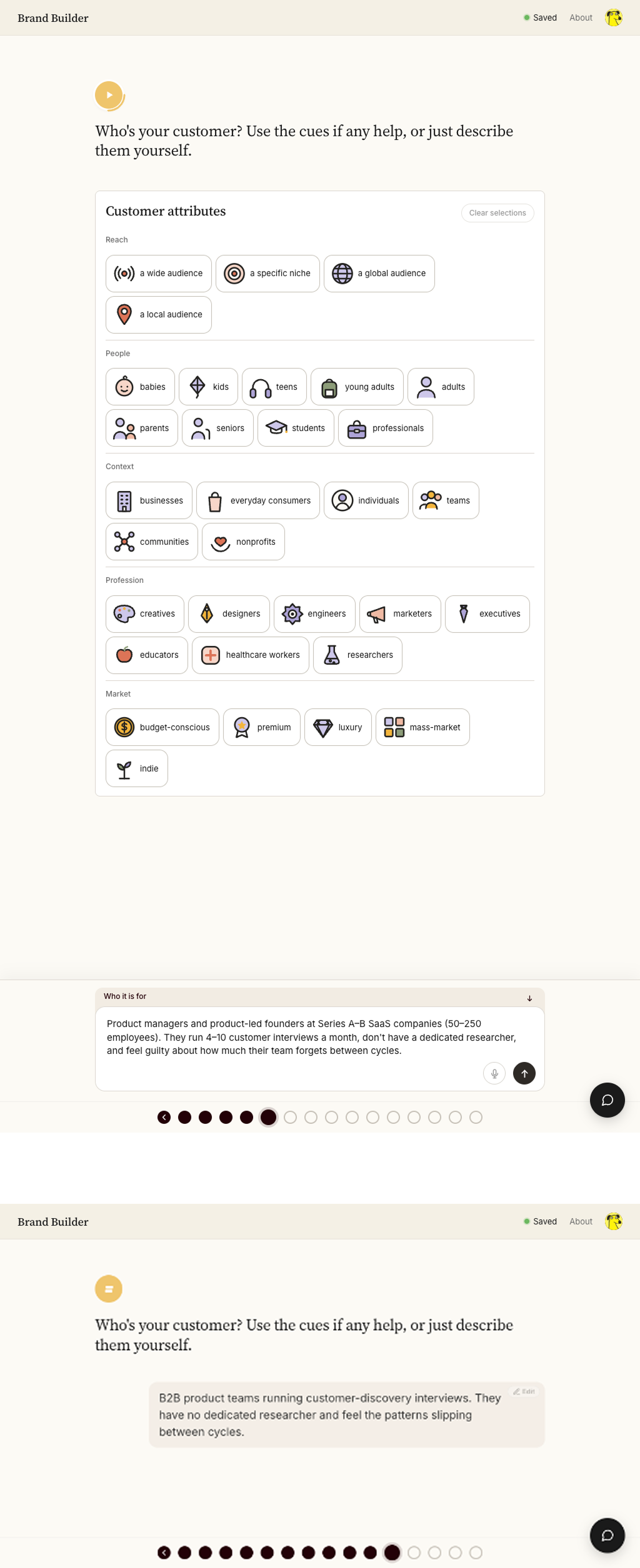
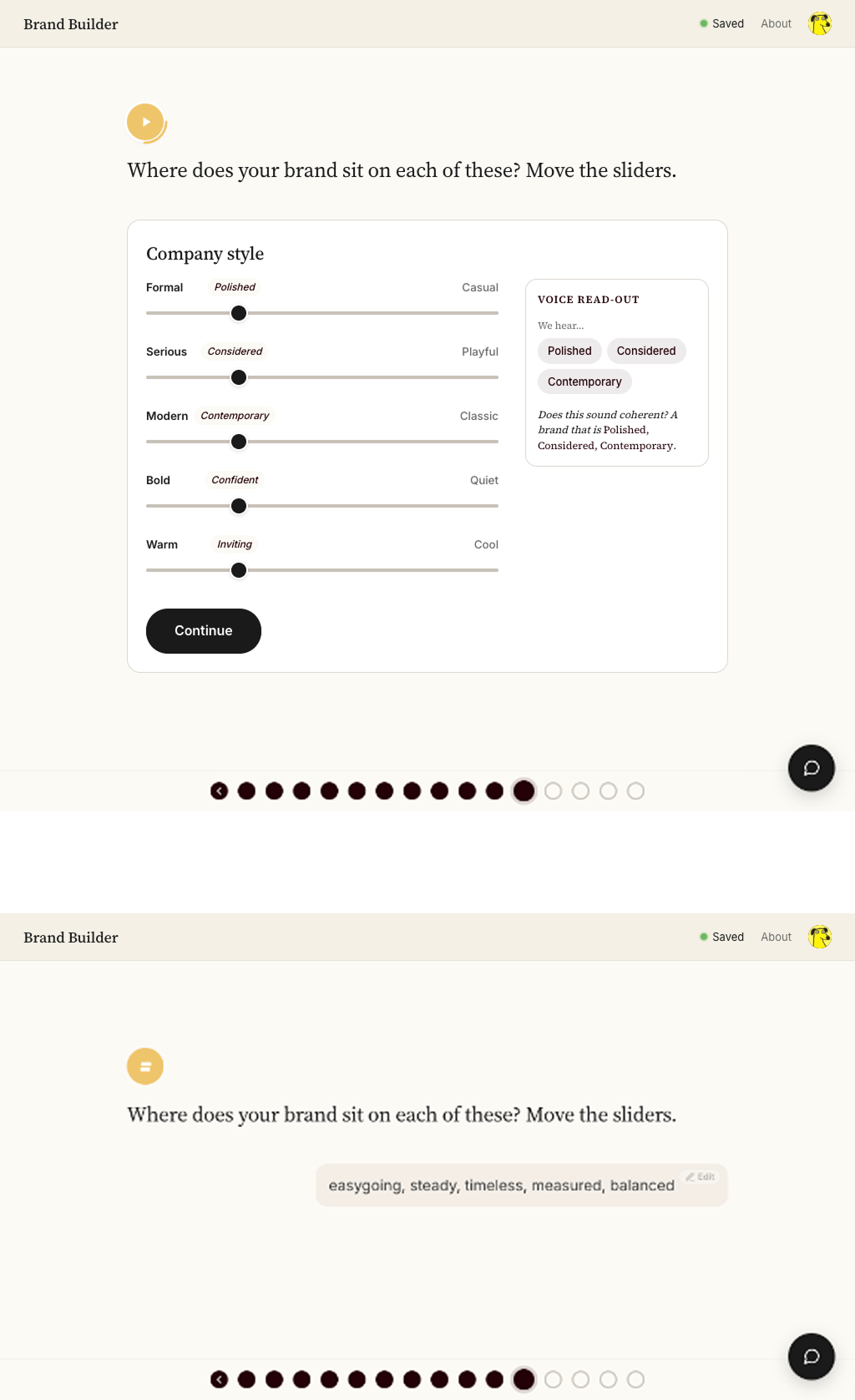
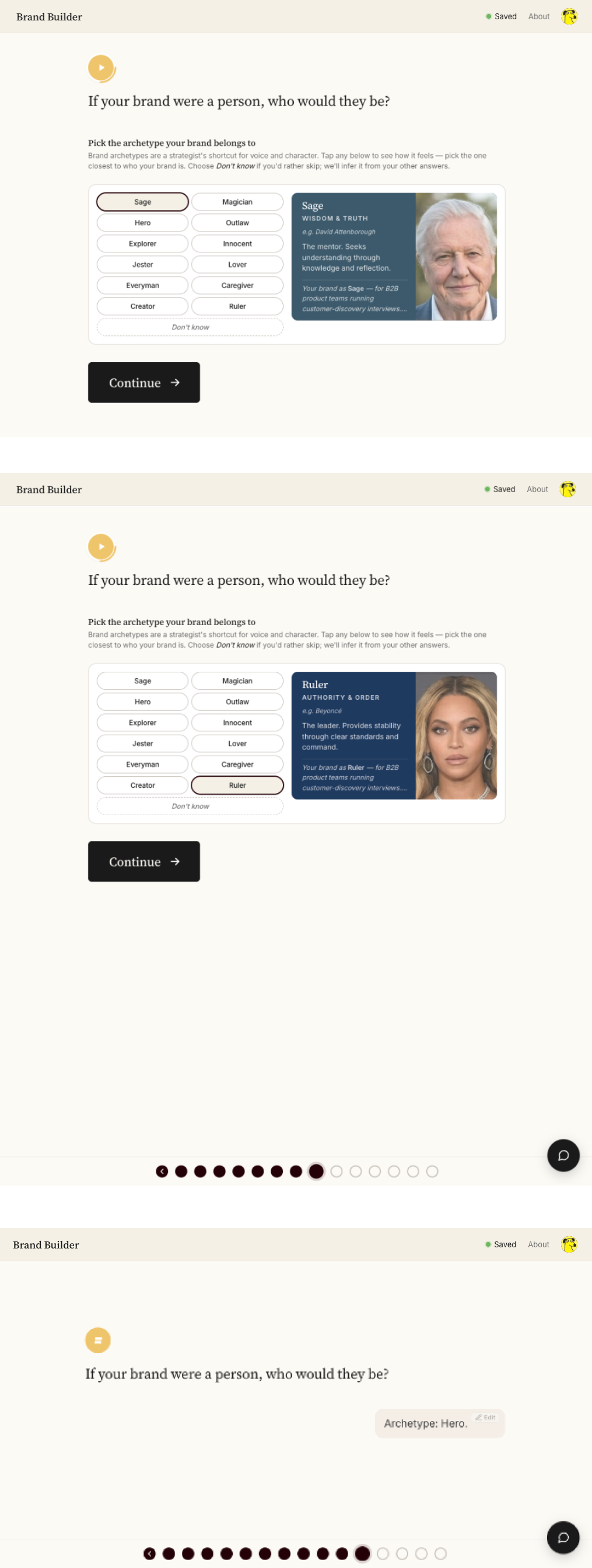
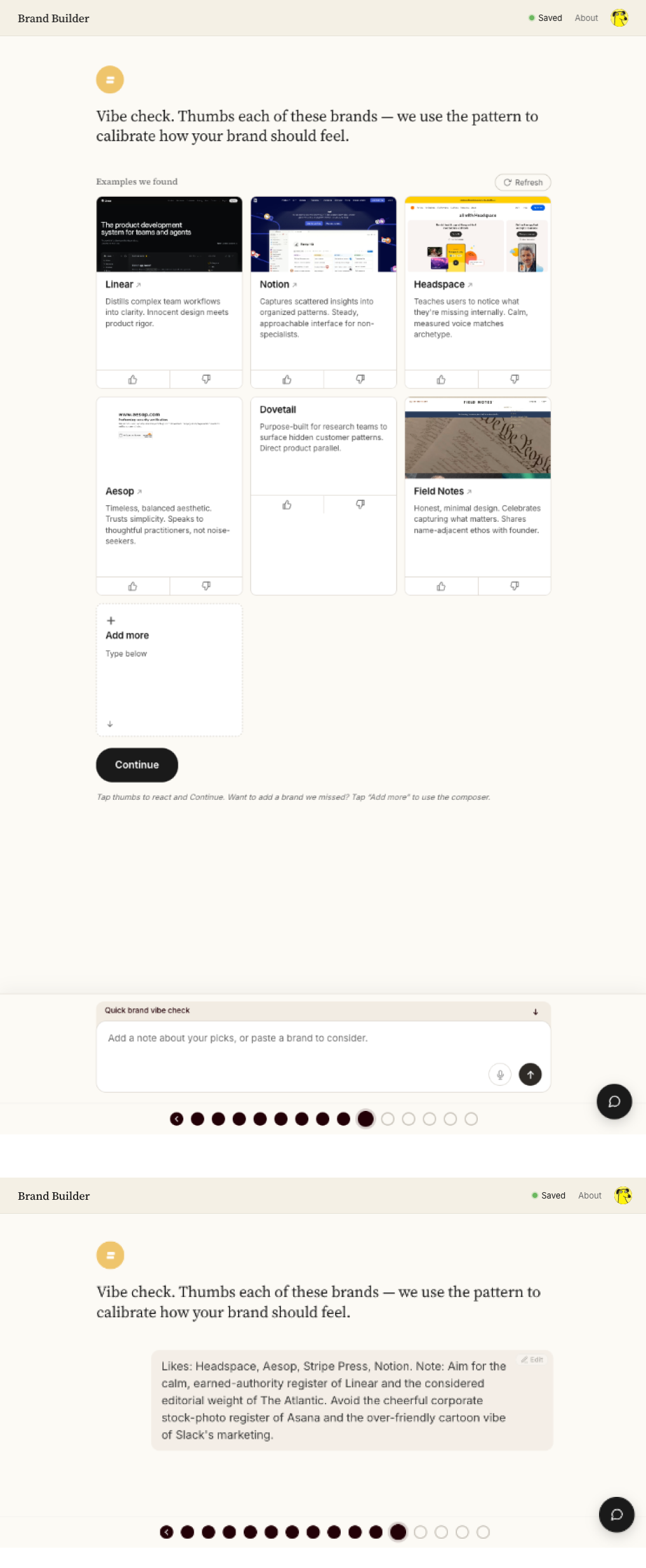
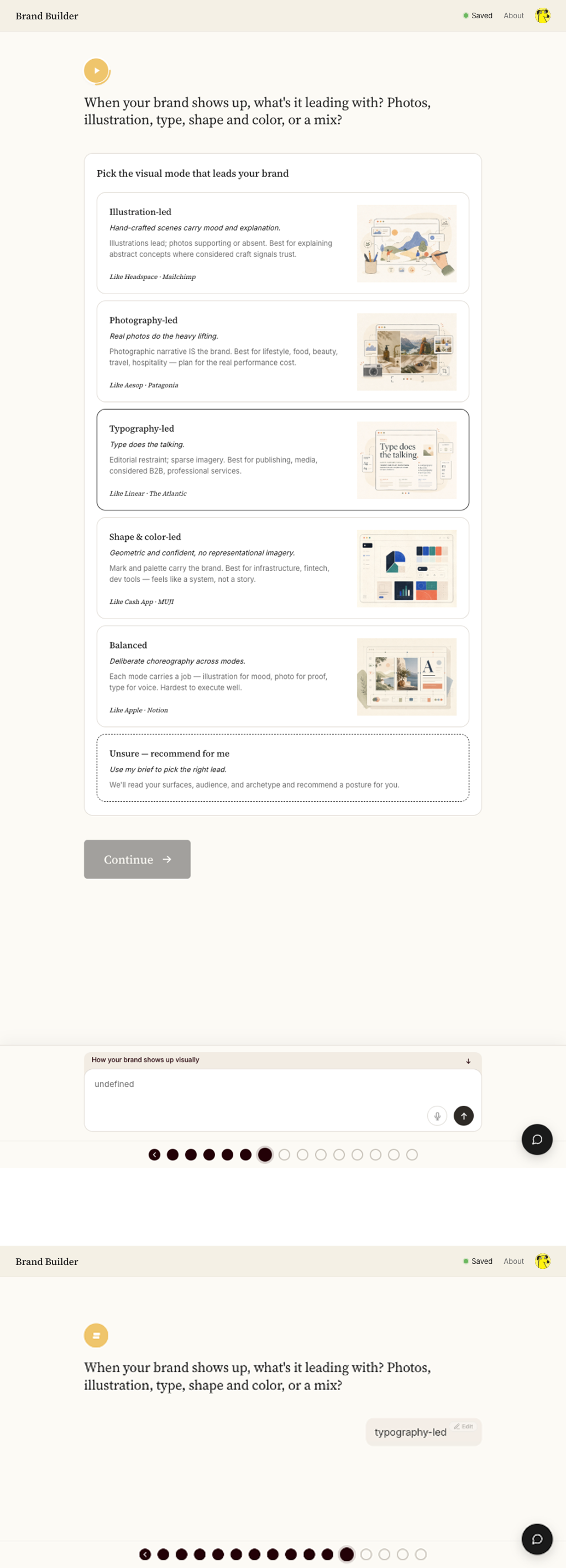
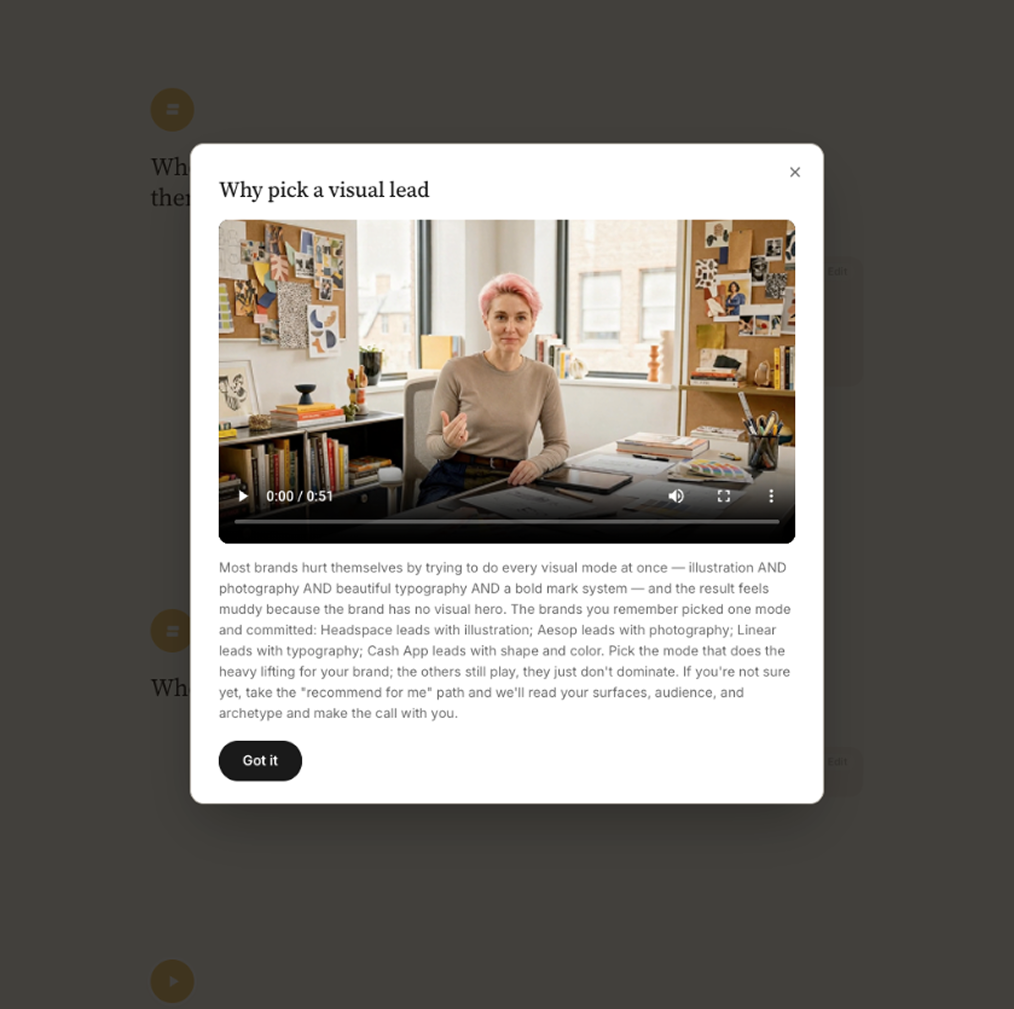
Chat intake
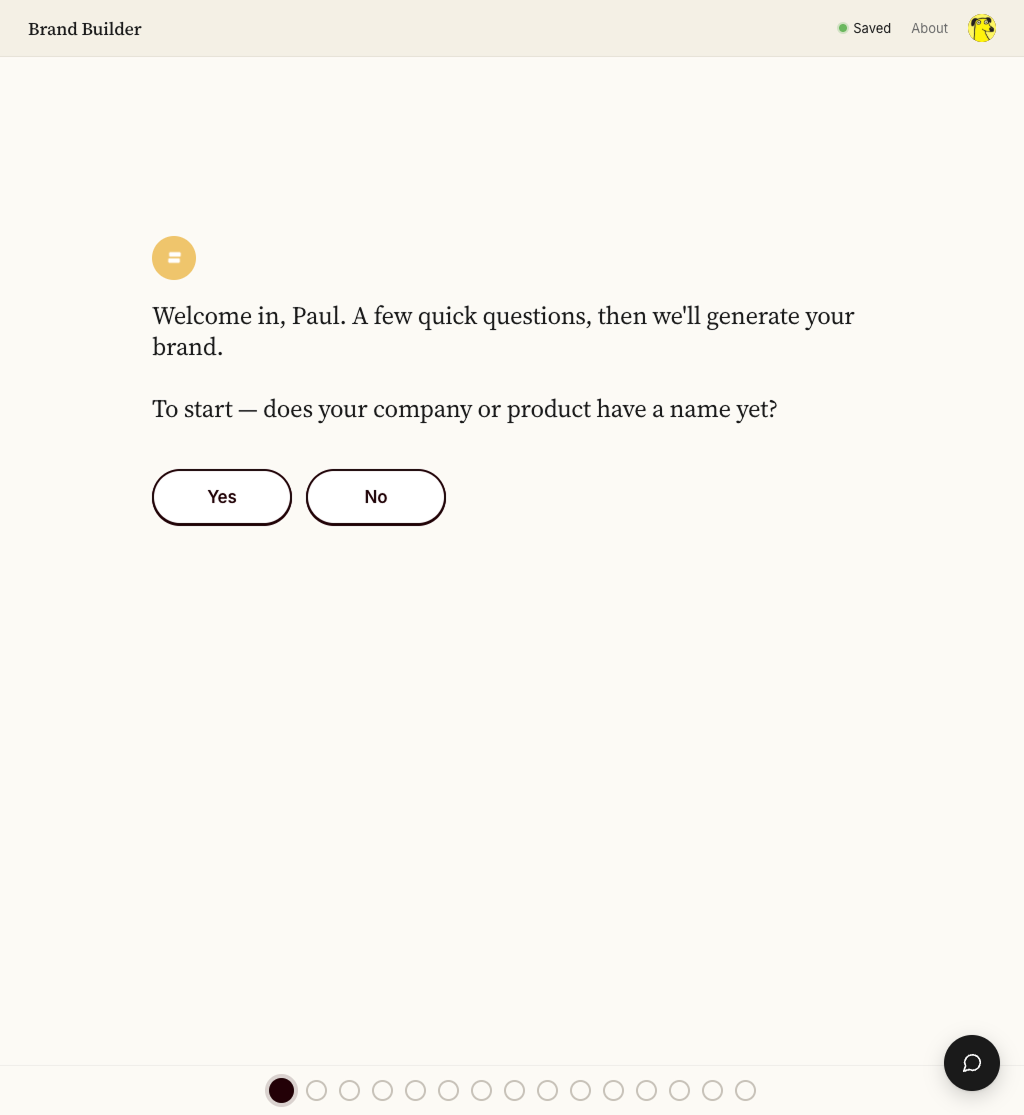
The founder arrives at a chat, not a form. Rotating placeholder text cycles through concrete openings — "The logo feels off," "Pre-launch, we need everything" — so a blank field never triggers paralysis. If they hesitate for six seconds, pain-point pills fade in as a soft nudge. Three minutes of conversation instead of a ten-minute questionnaire. The shape of their answers shapes what comes next.

2. Visual checkpoints
Two human-in-the-loop moments where the founder commits — always to a specific visual direction, never an abstraction.
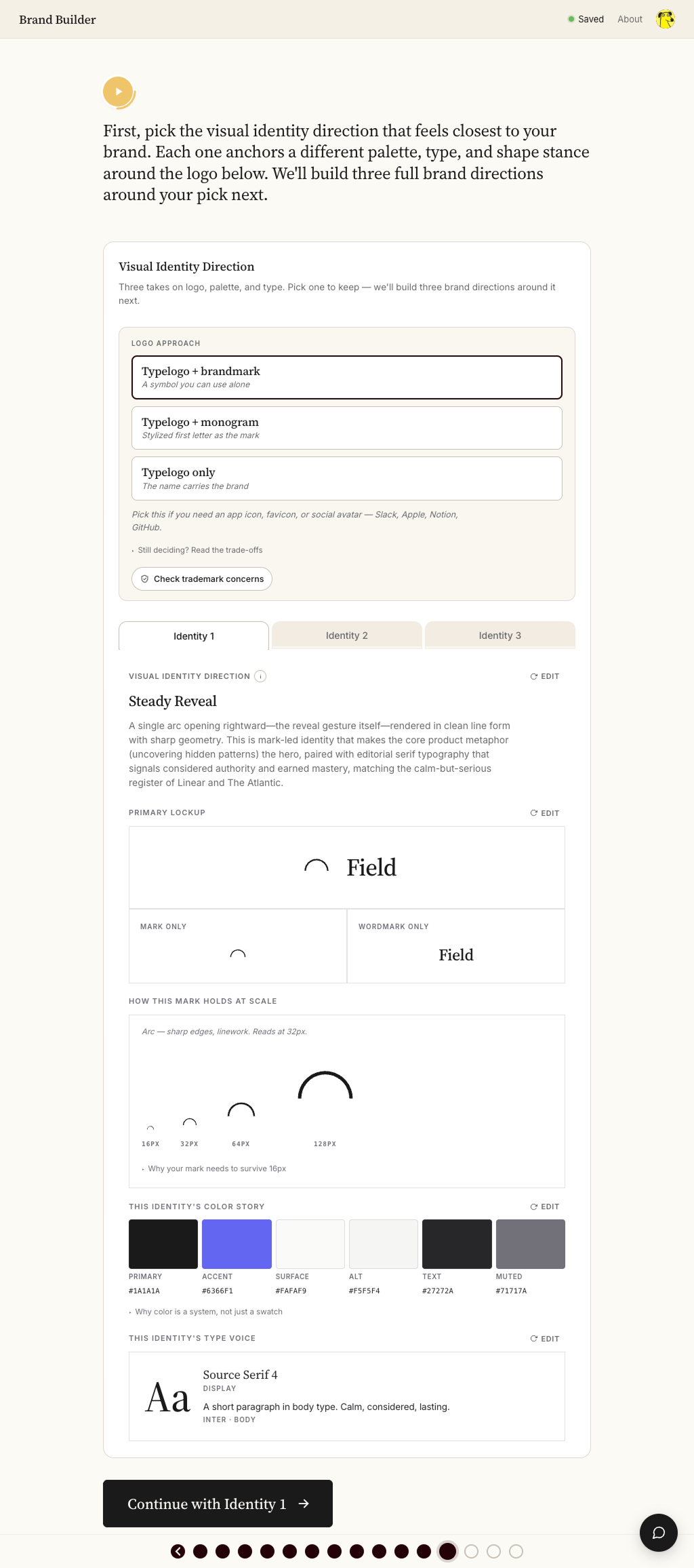
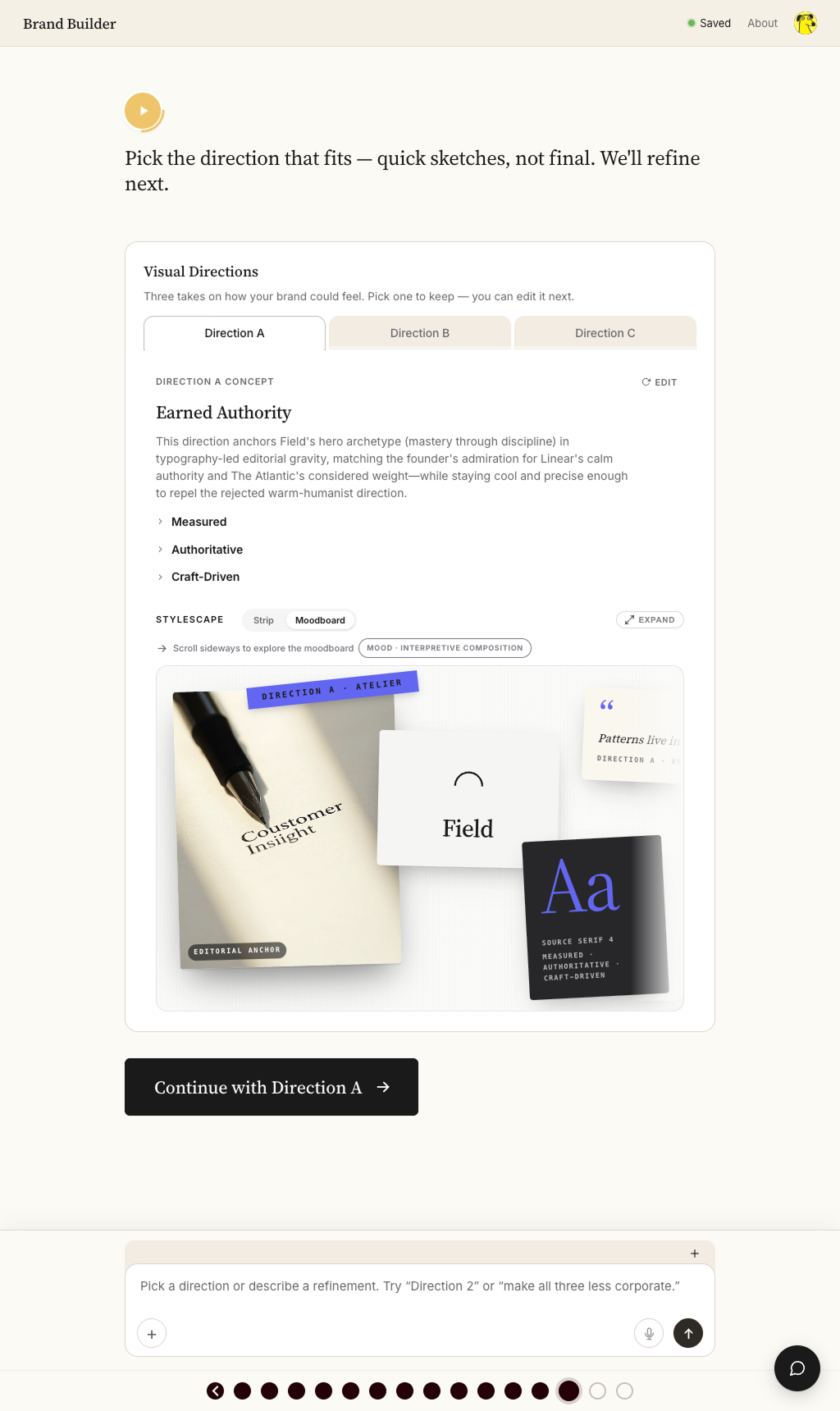
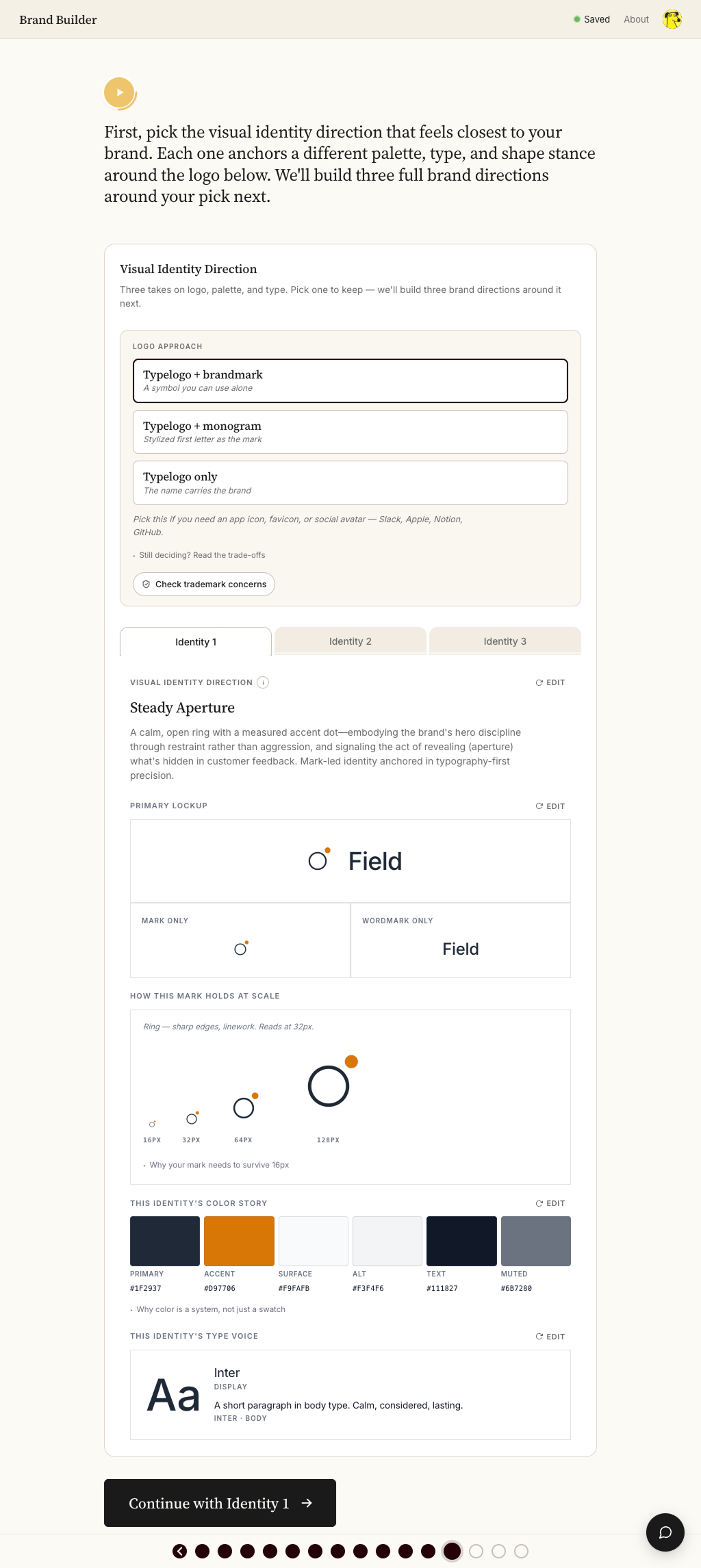
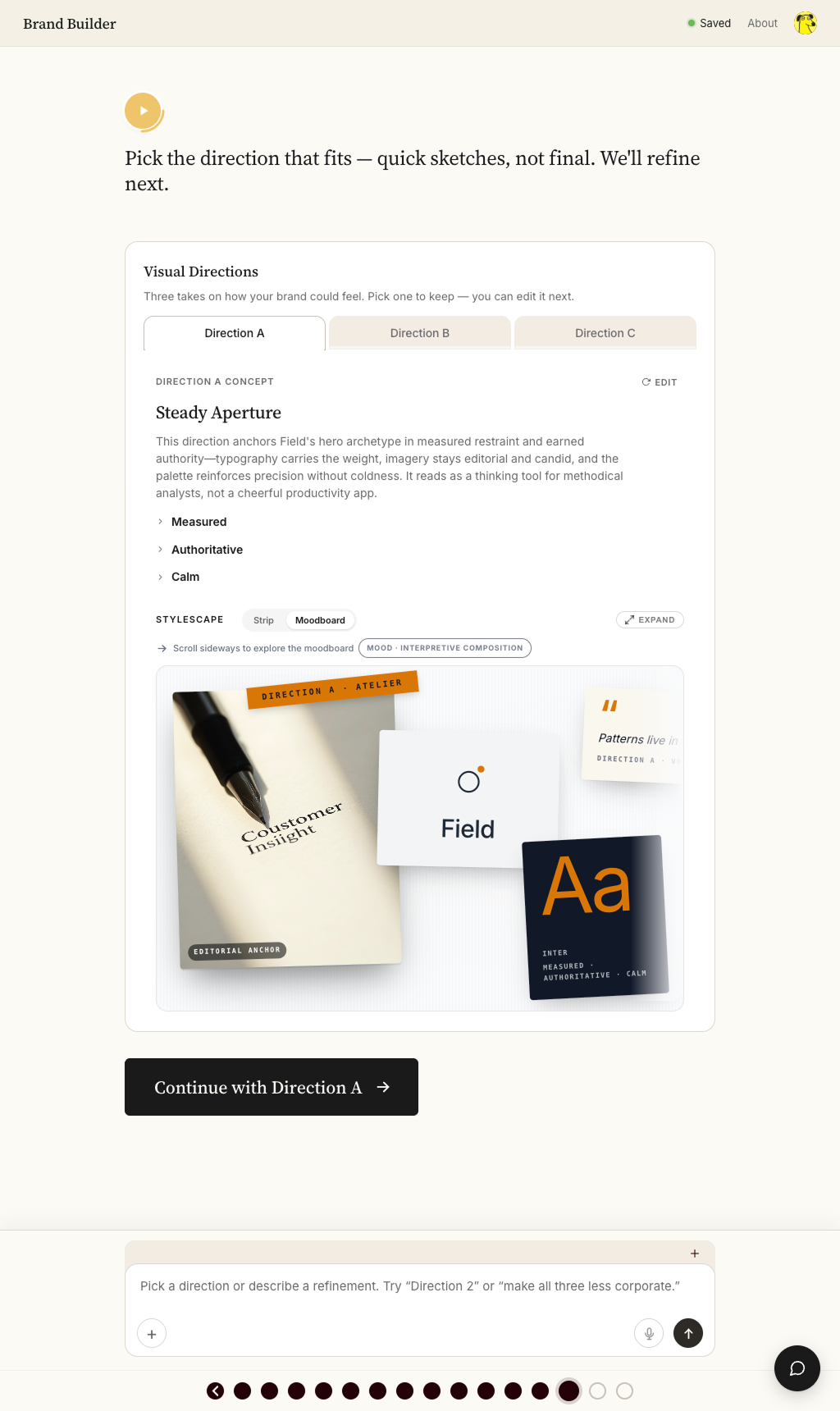
First: three identity directions rendered as complete specimens — palette, type, and mark inside real product cards and marketing headlines. The founder picks one; it becomes the spine.
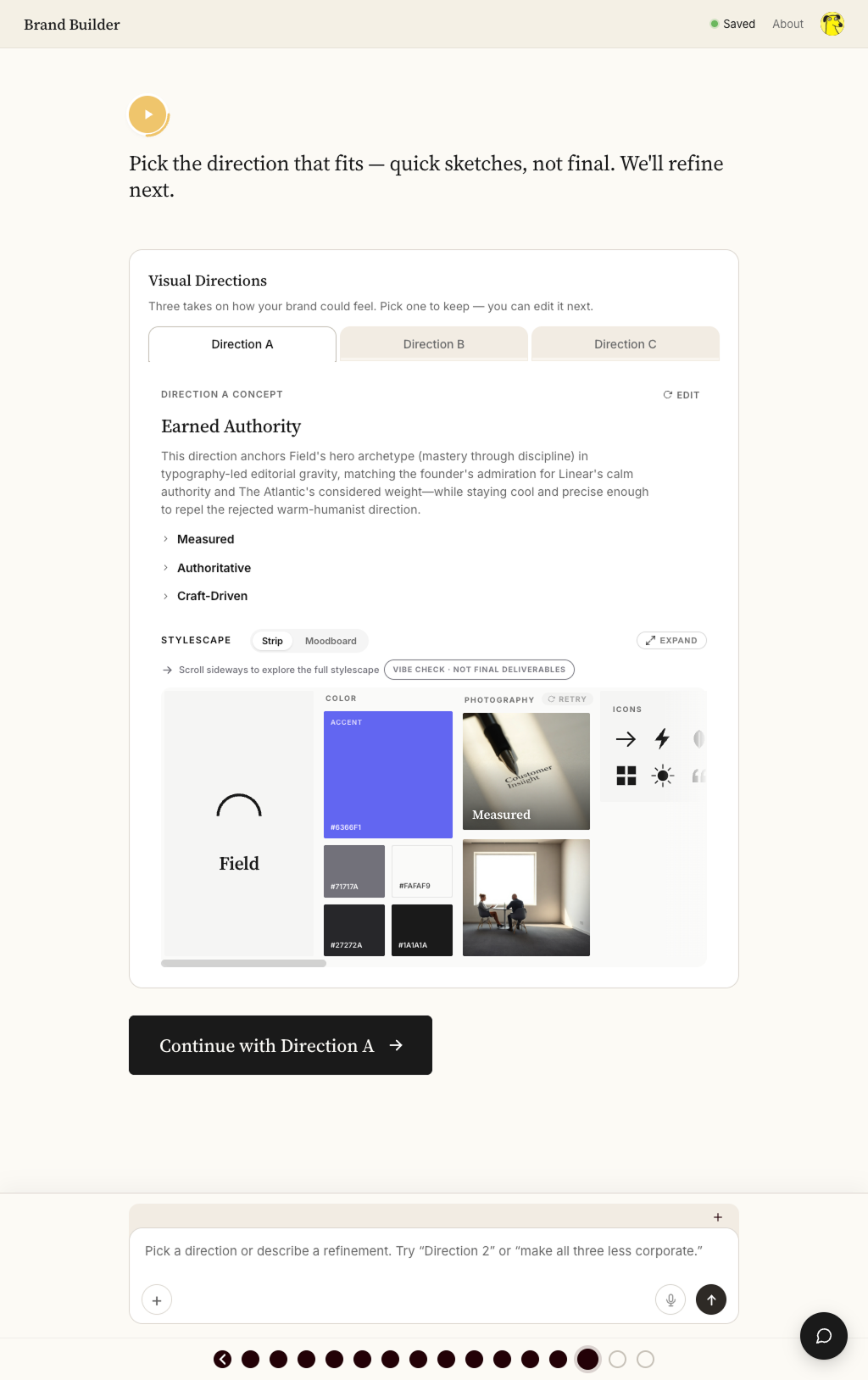
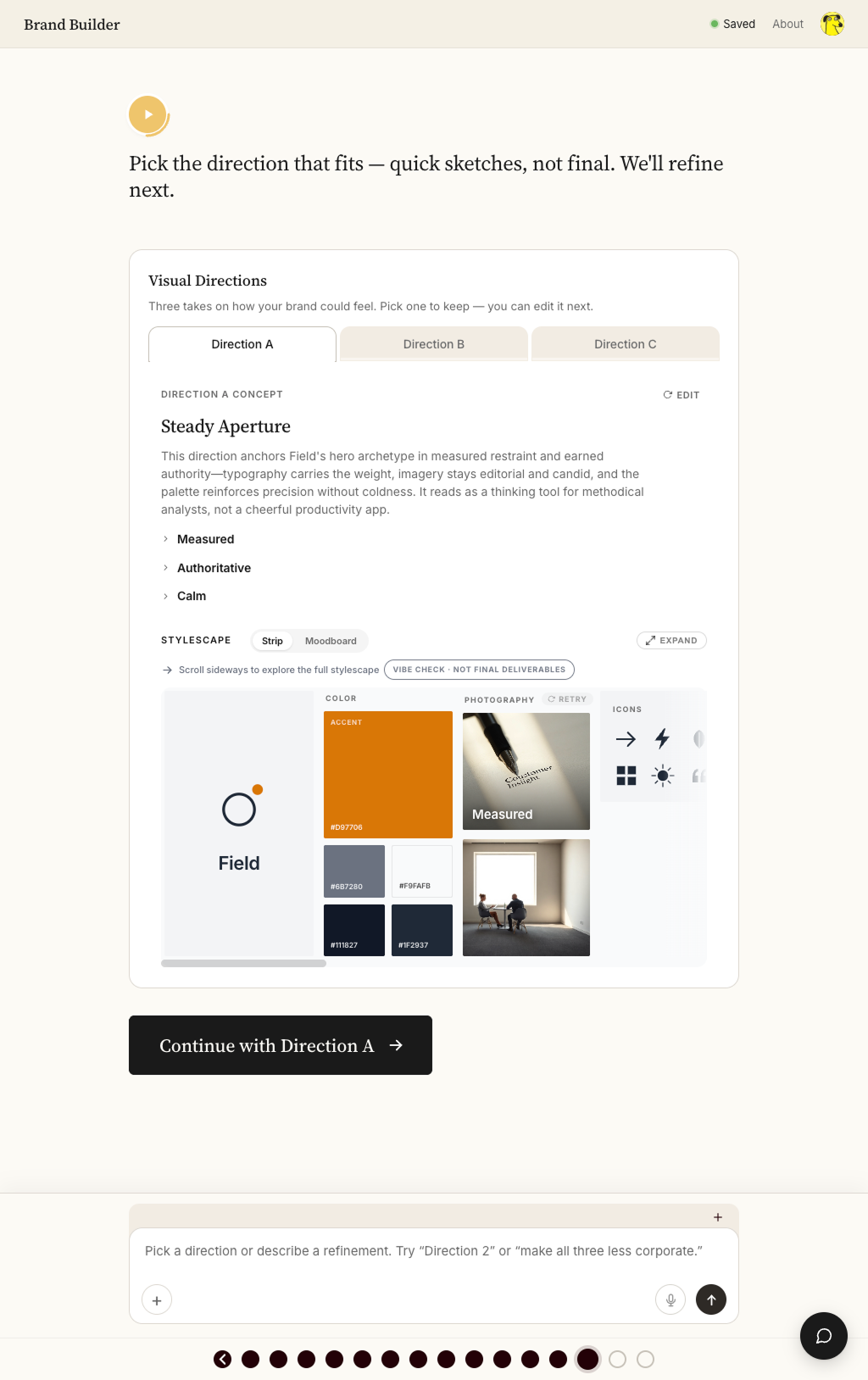
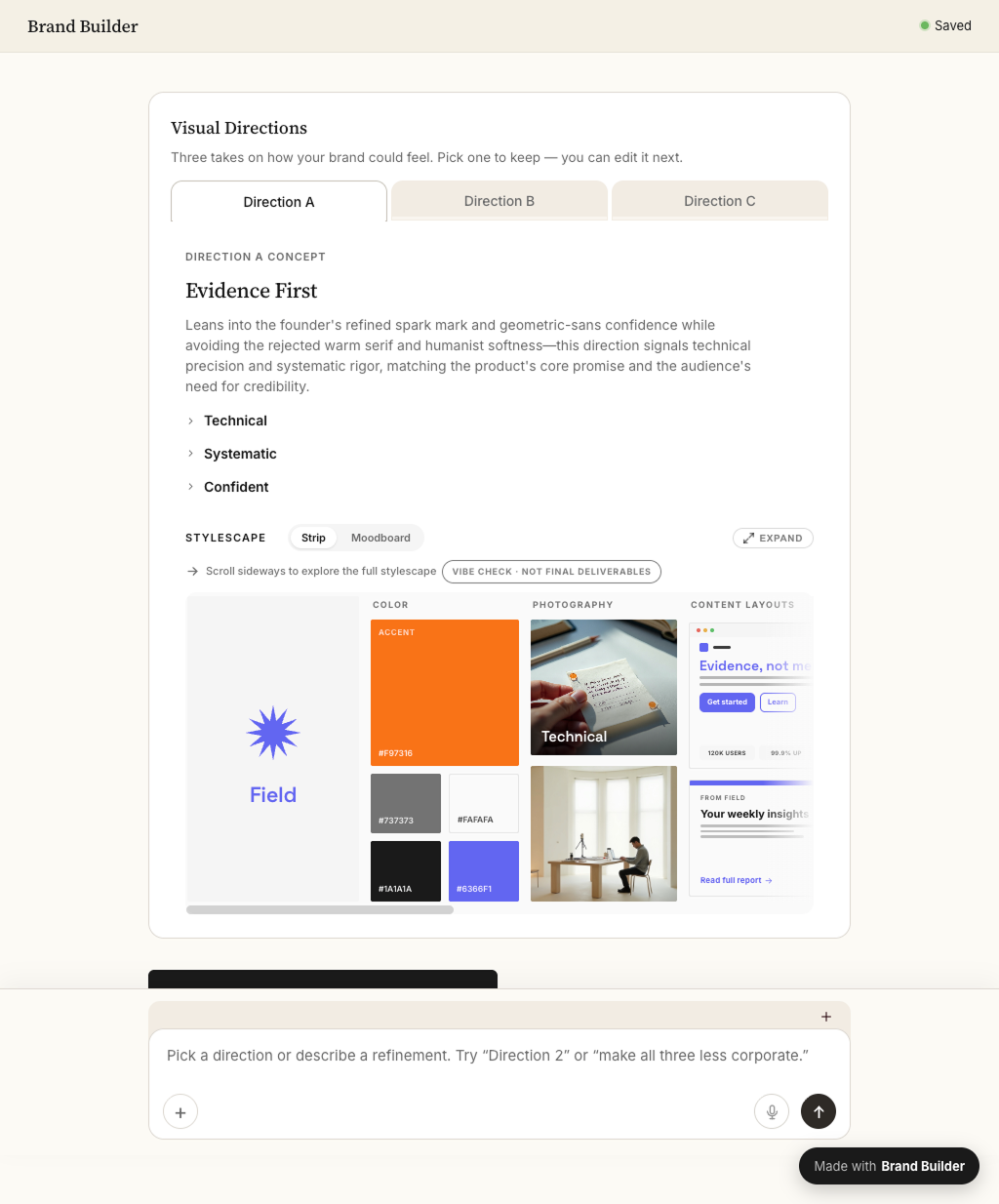
Second: a full-width stylescape strip pressure-testing the chosen system against the surfaces the brand will actually live on — marketing site, product UI, photography, illustration, layouts. Every tile carries an inline retry composer. Type "warmer lighting, less studio feel" and your words flow back through the same prompt builder that generated the original. Feedback is a first-class design surface, not an escape hatch.
3. Final deliverables
Full brand suite, each artifact fully realized in the founder's palette, type, and imagery — not sample templates dressed in their colors.
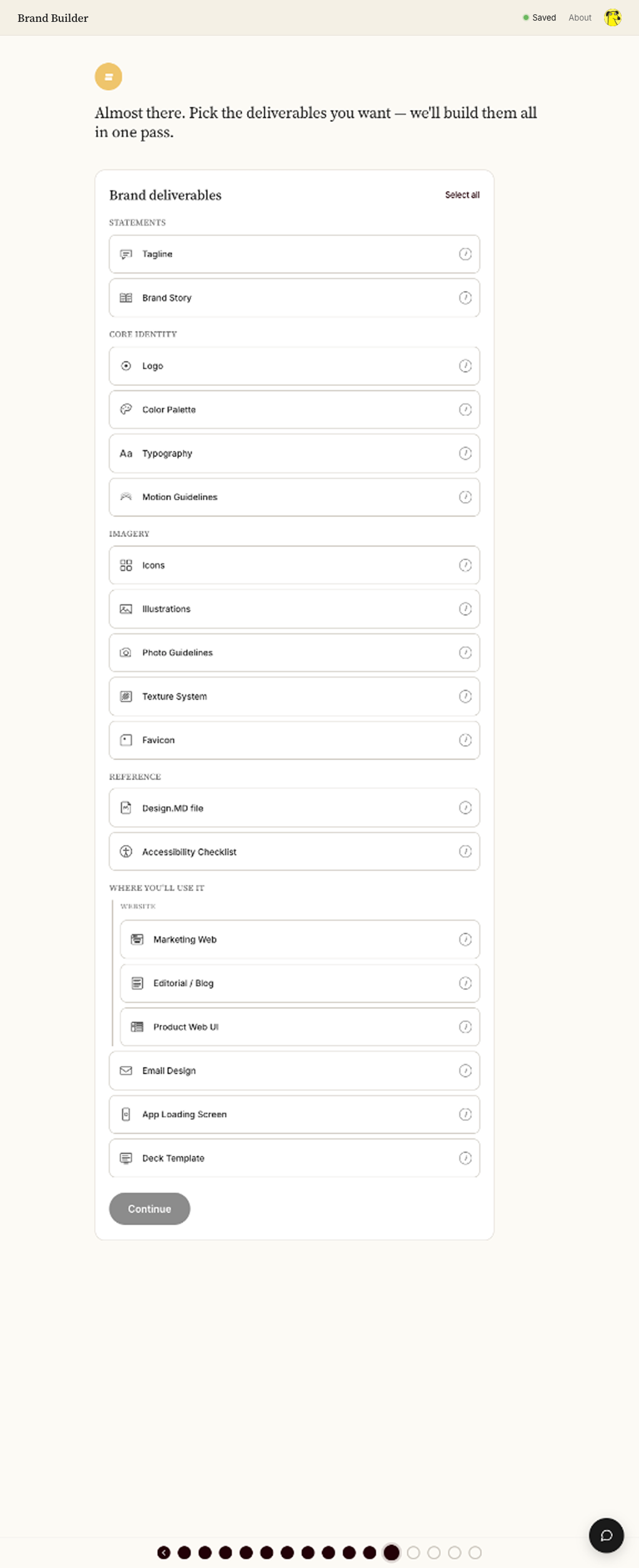
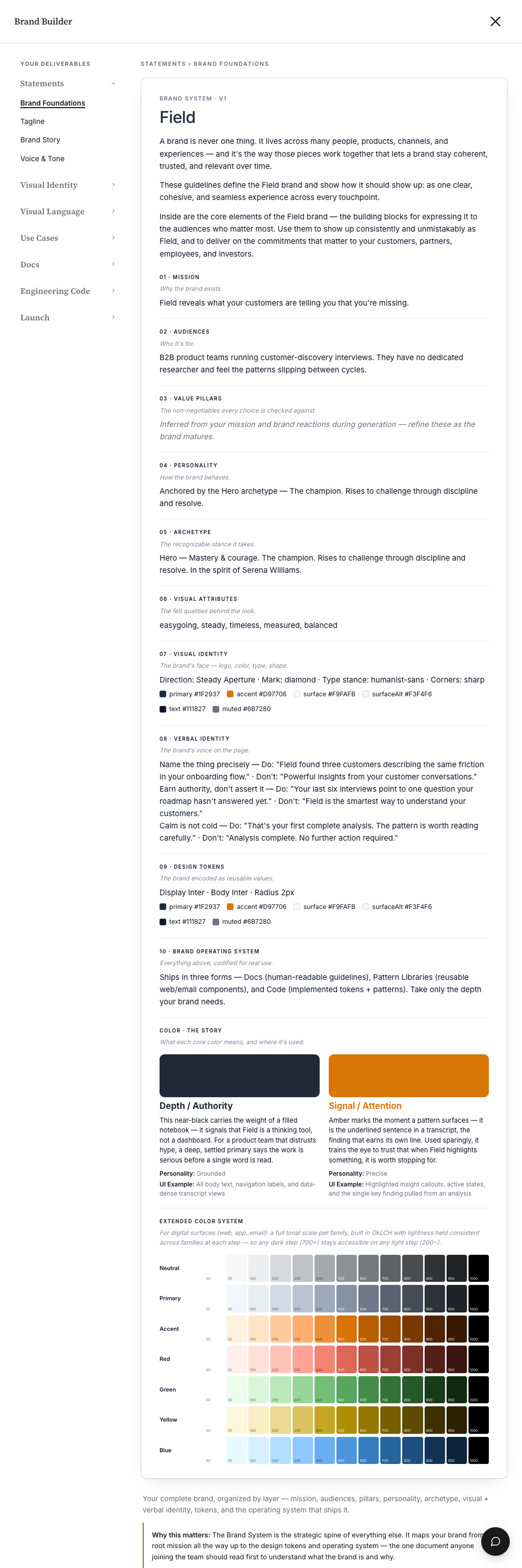
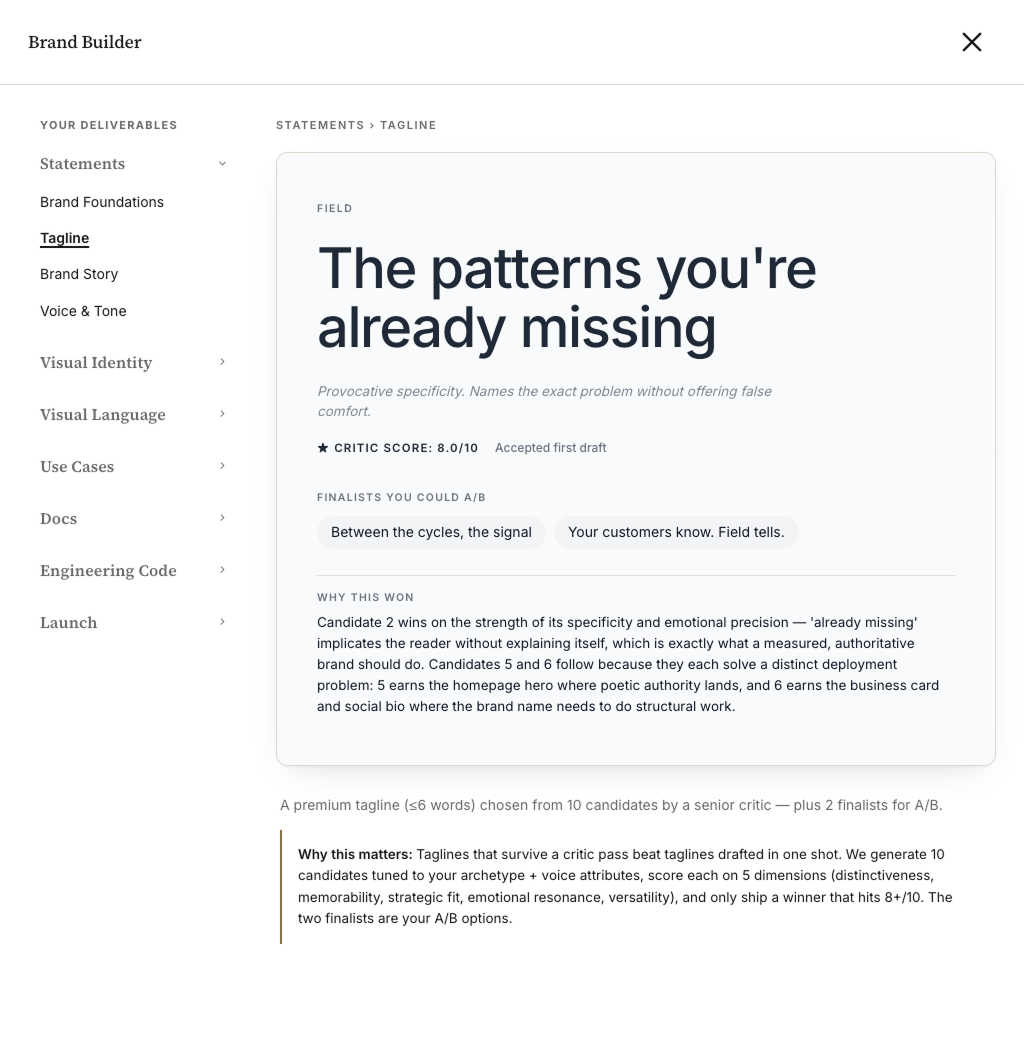
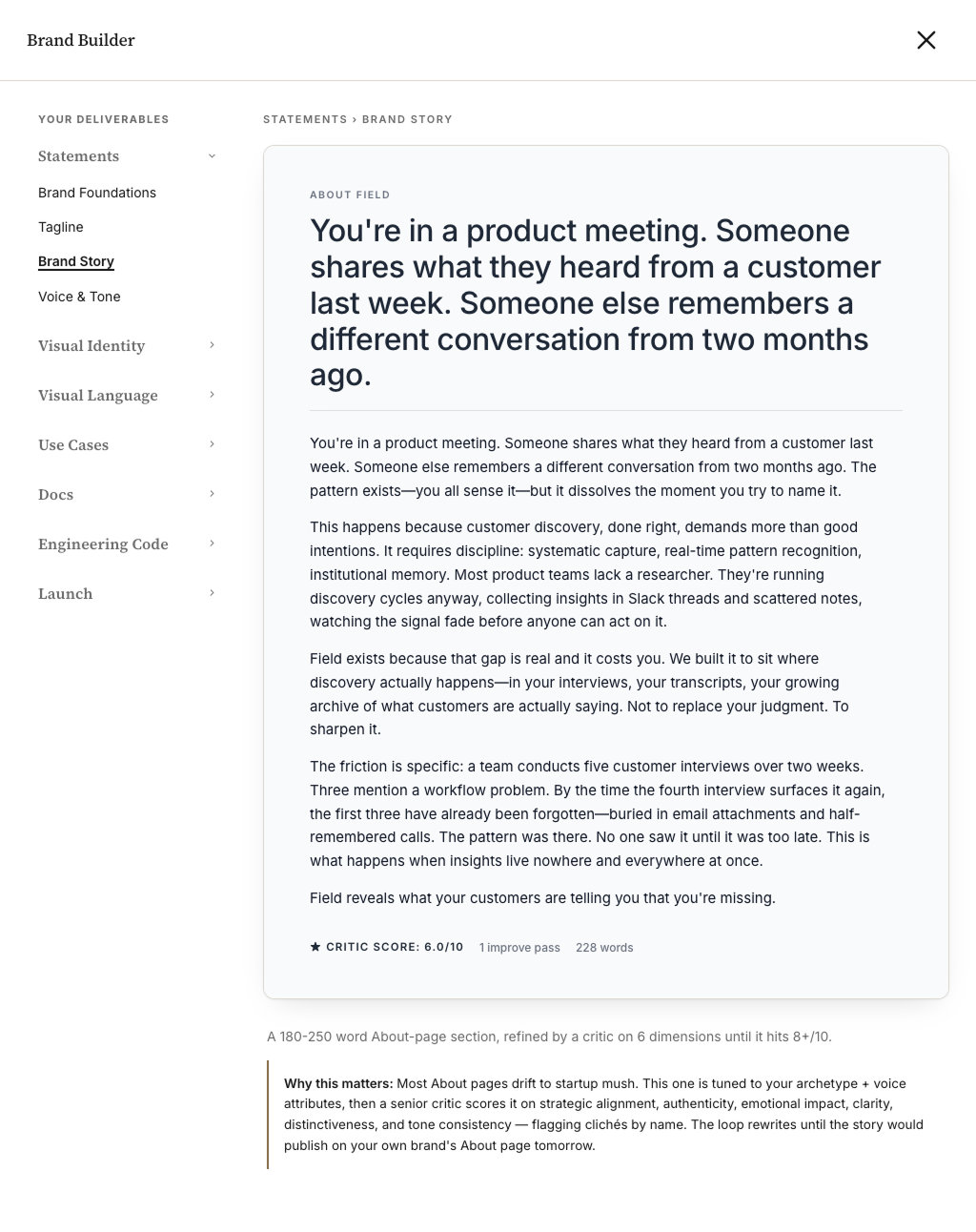
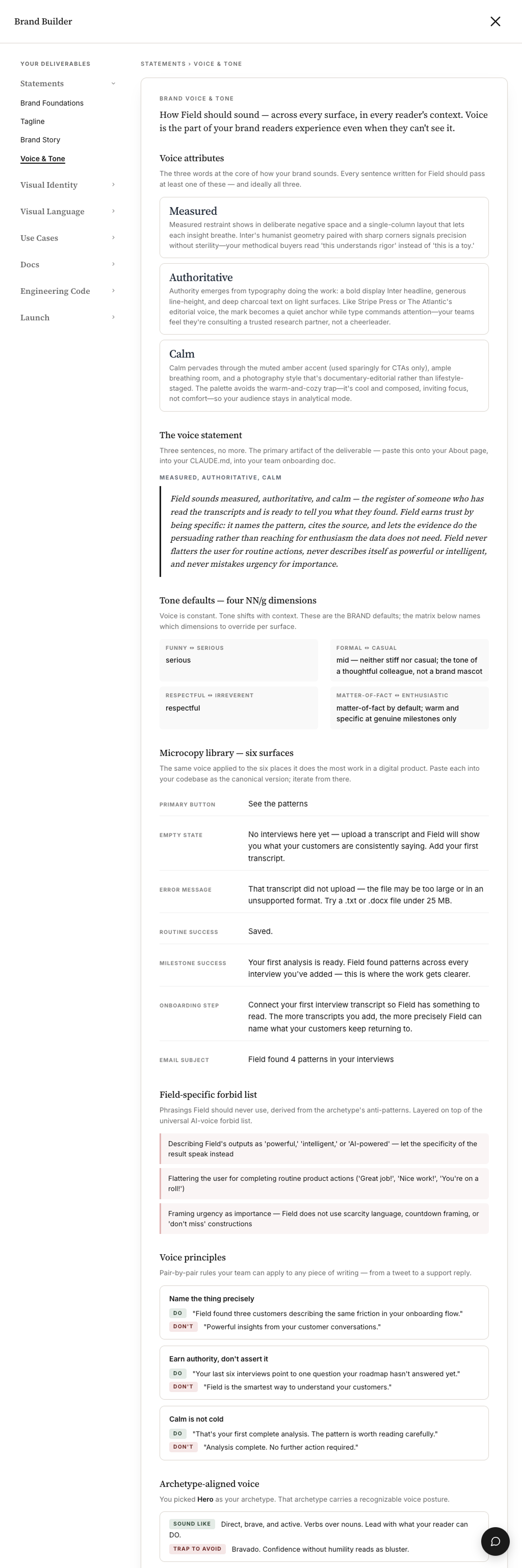
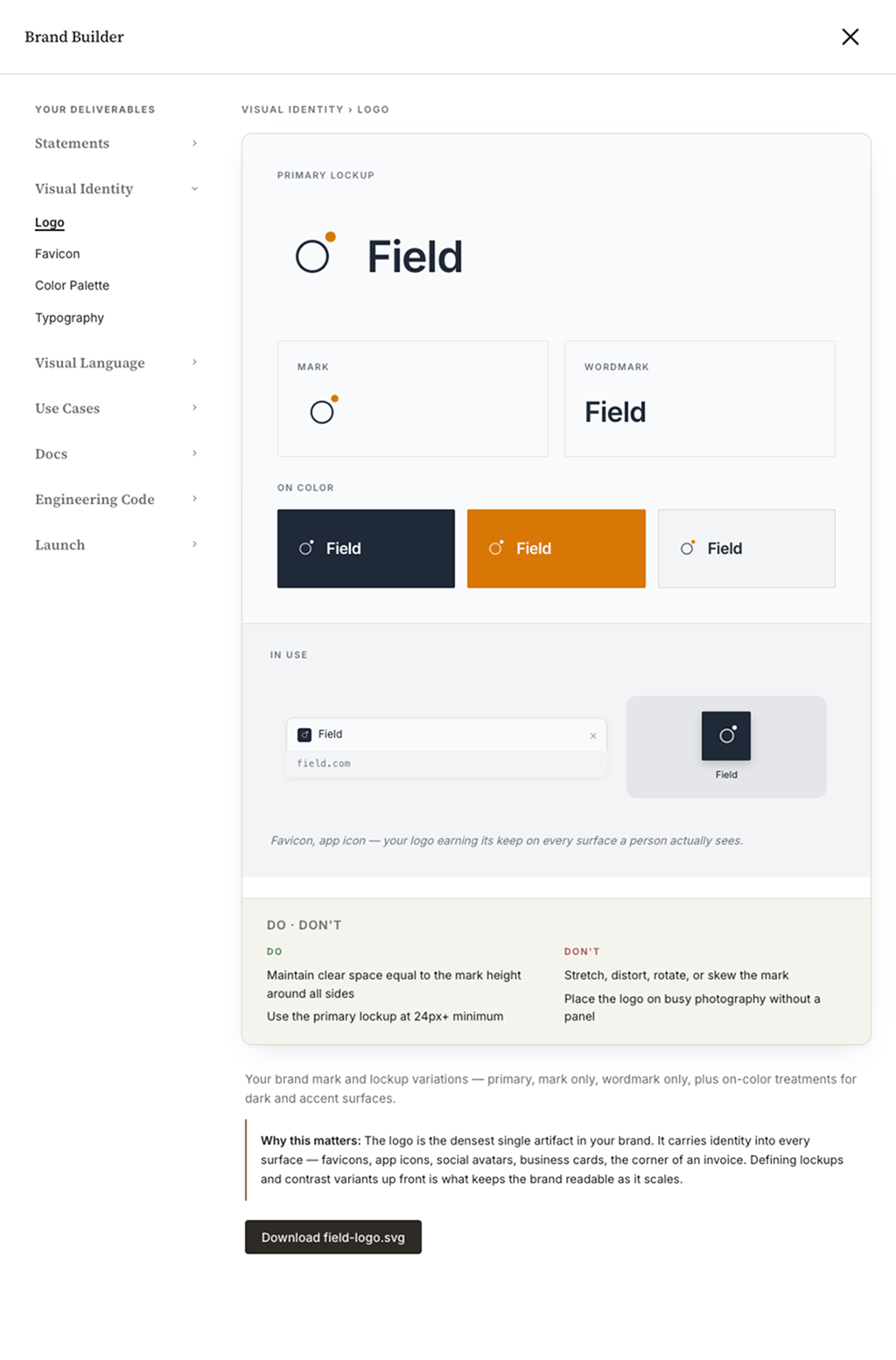
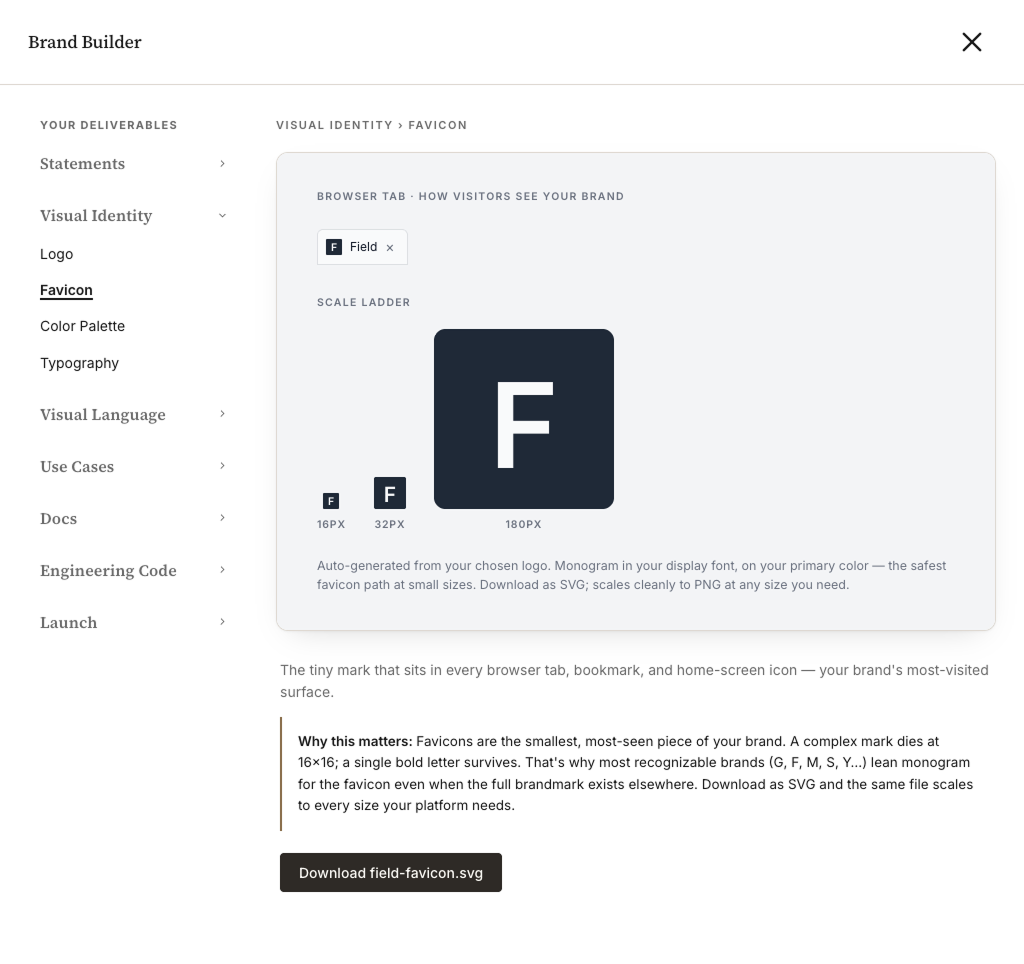
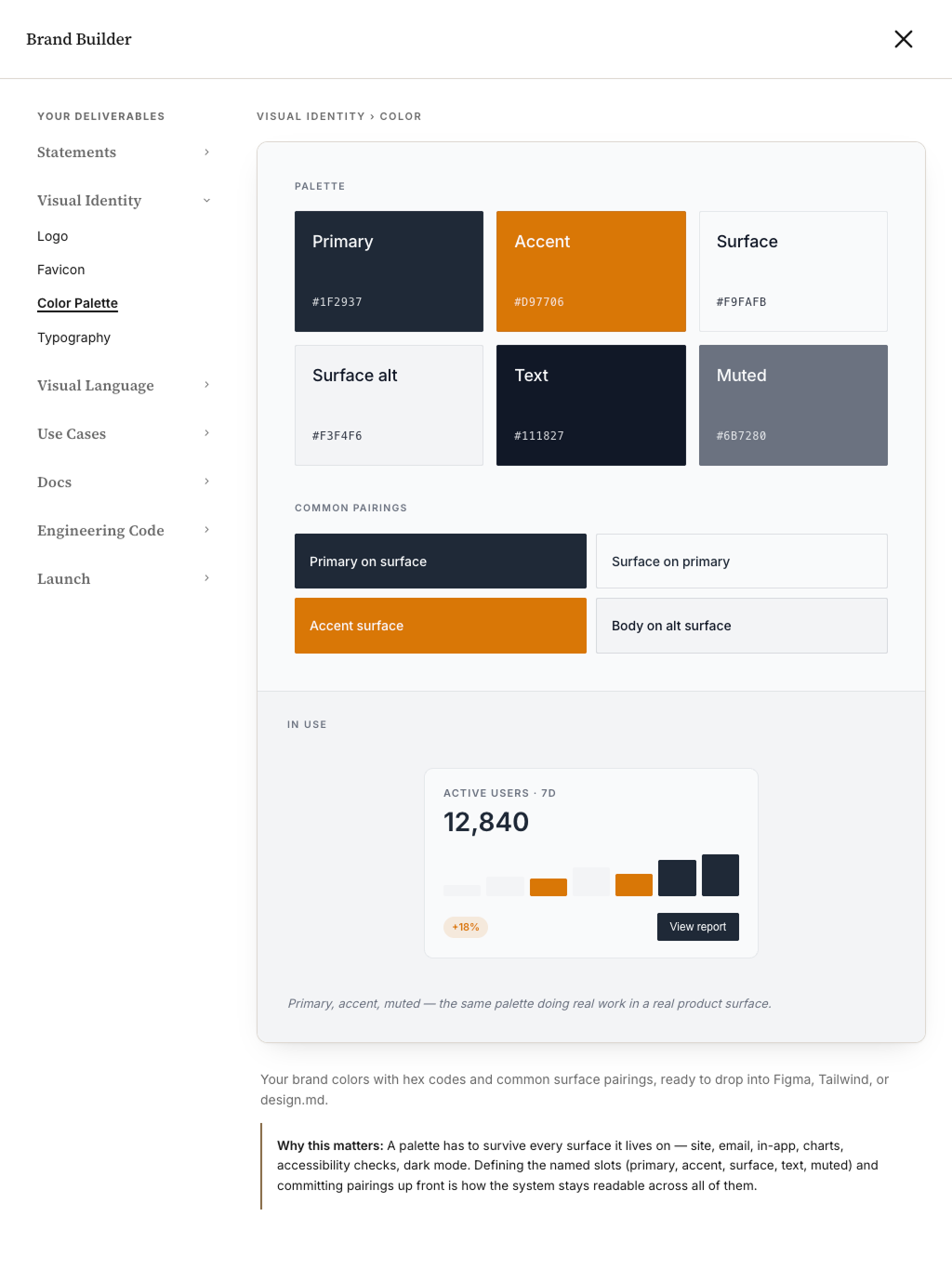
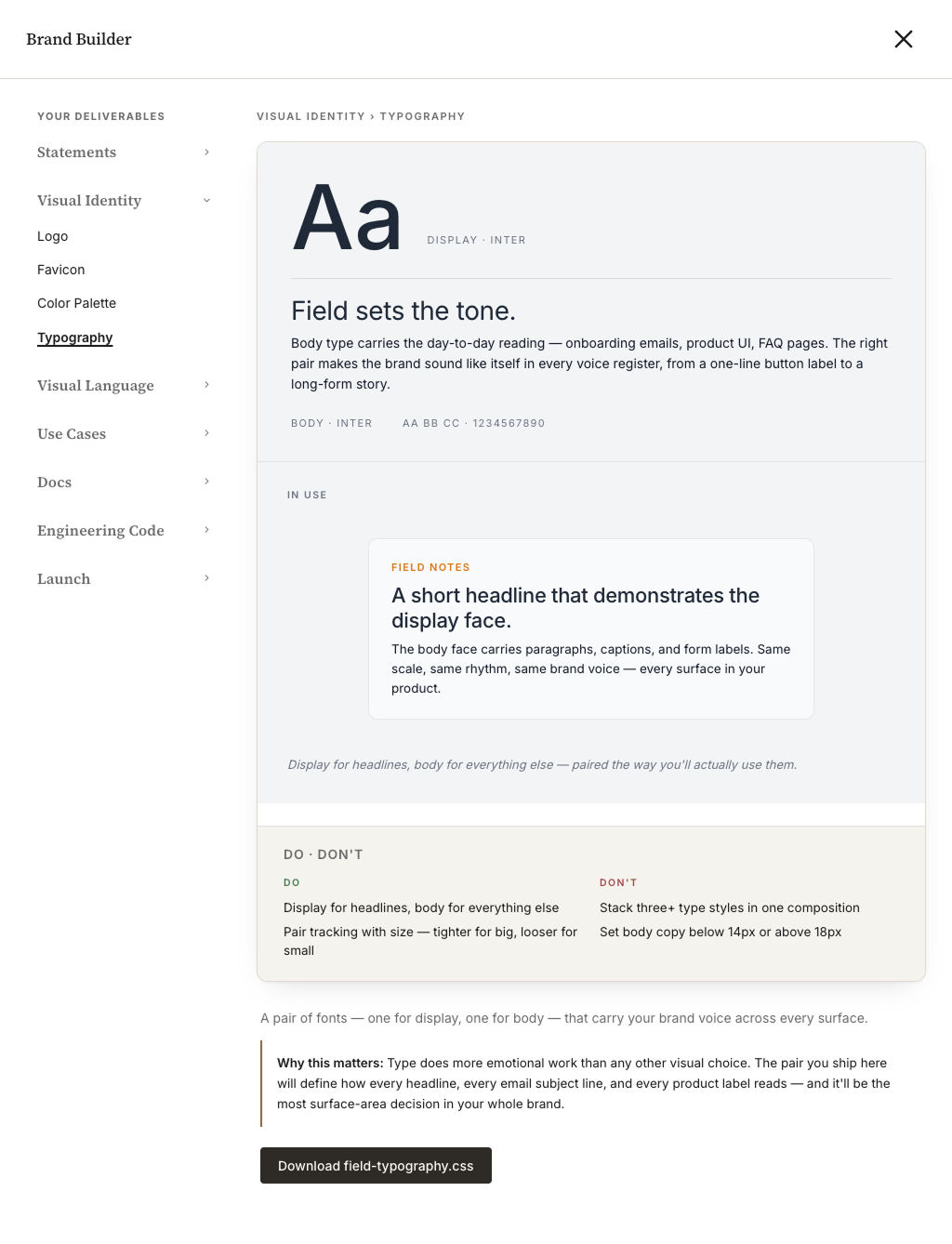
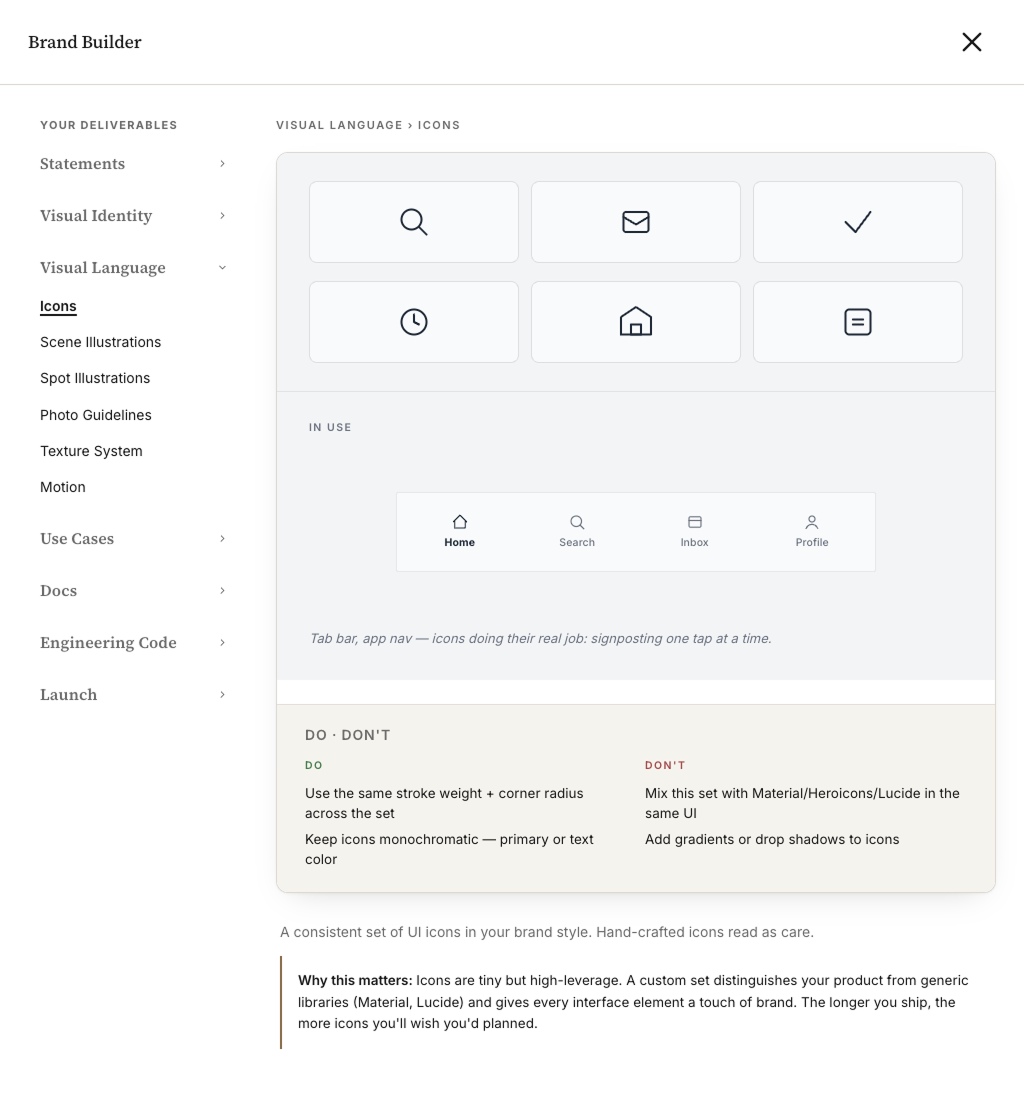
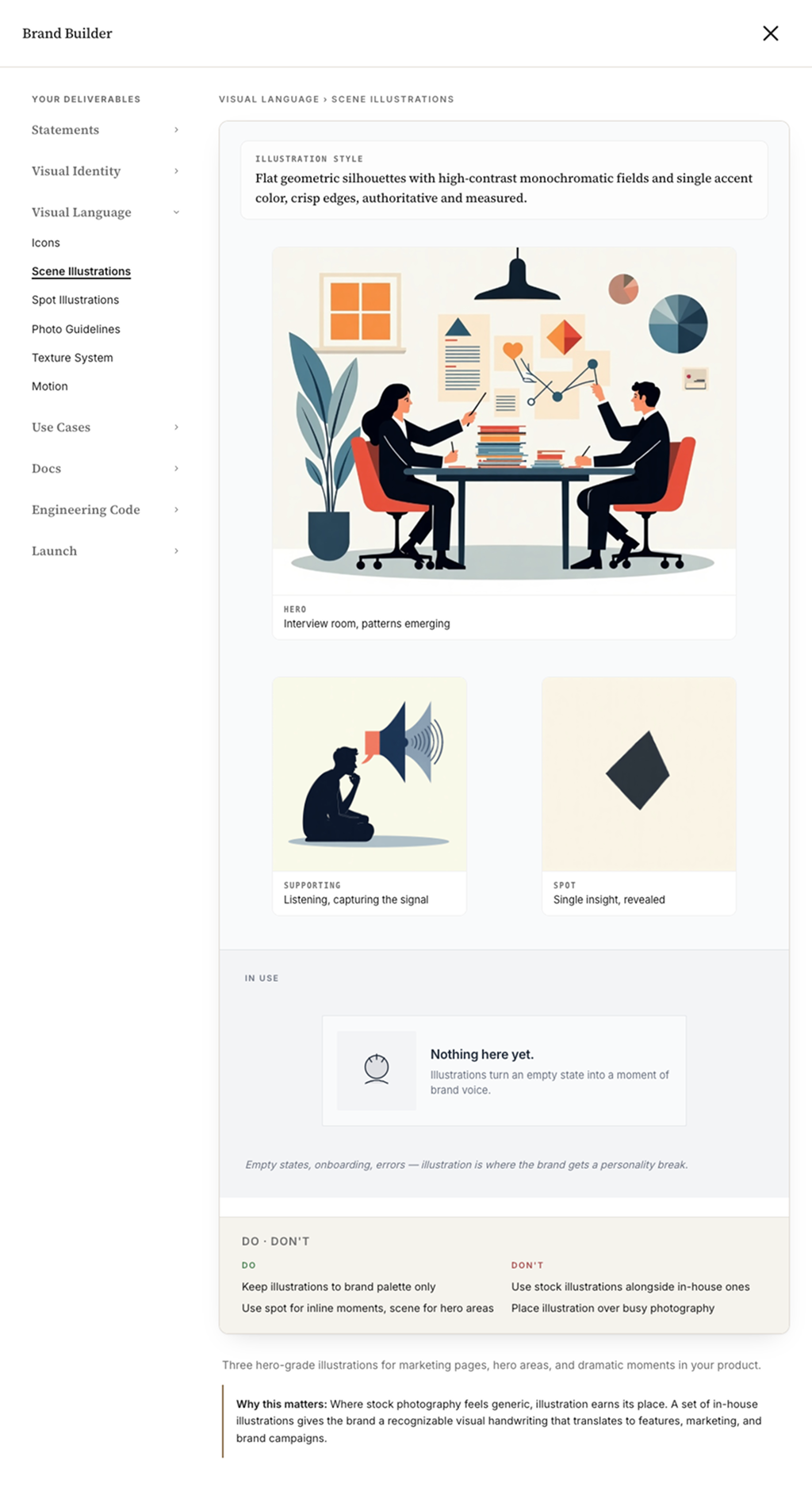
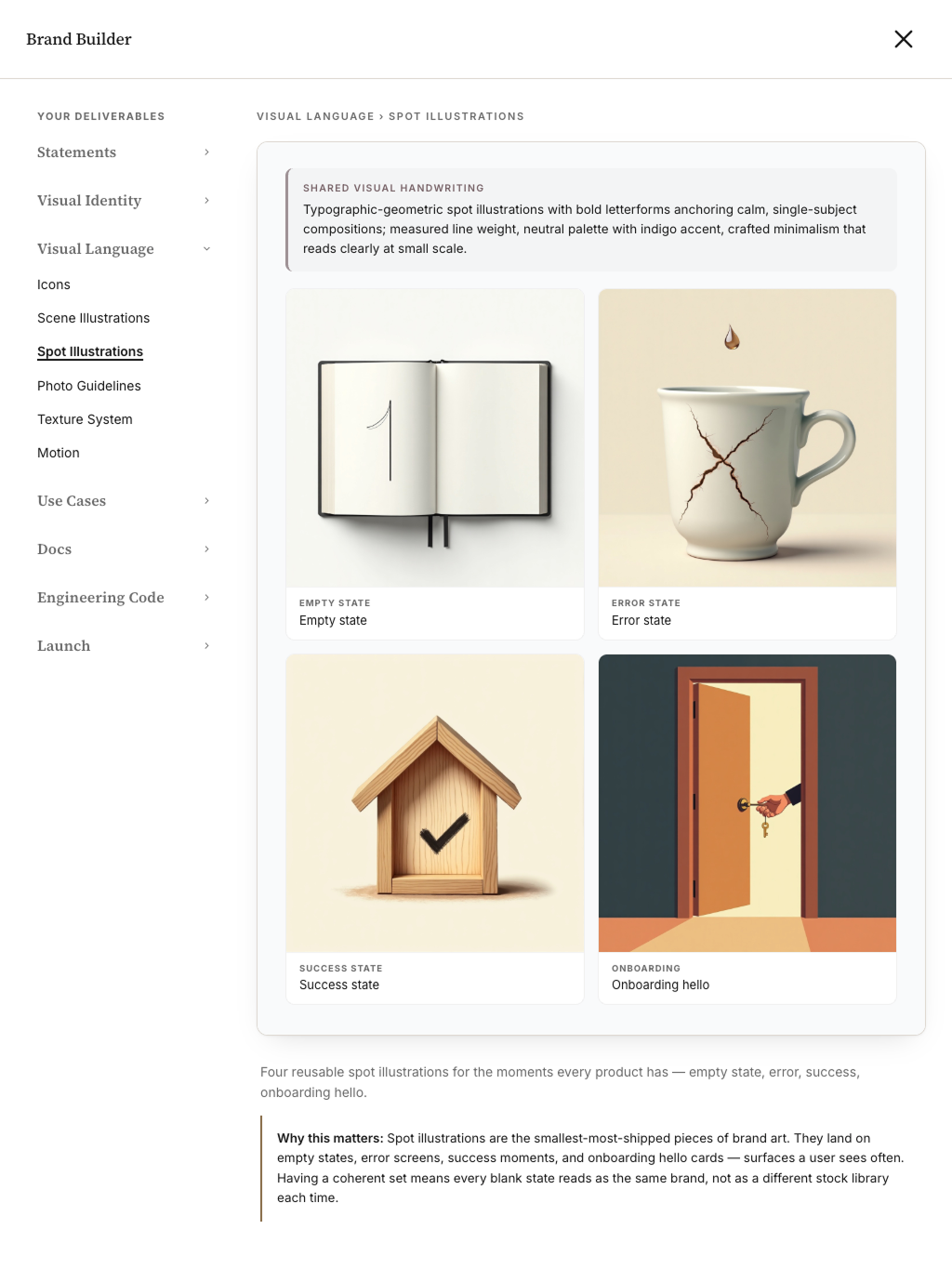
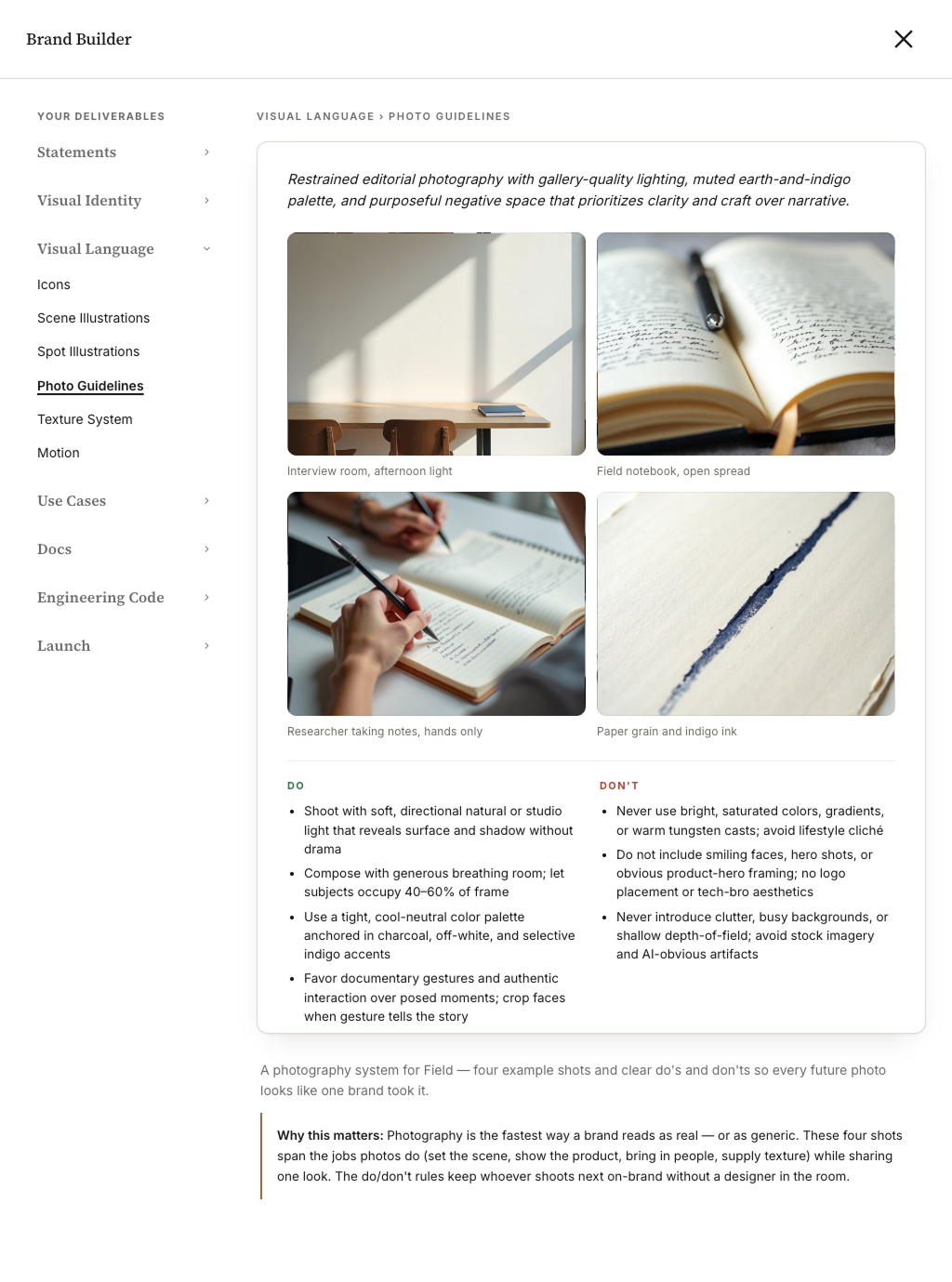
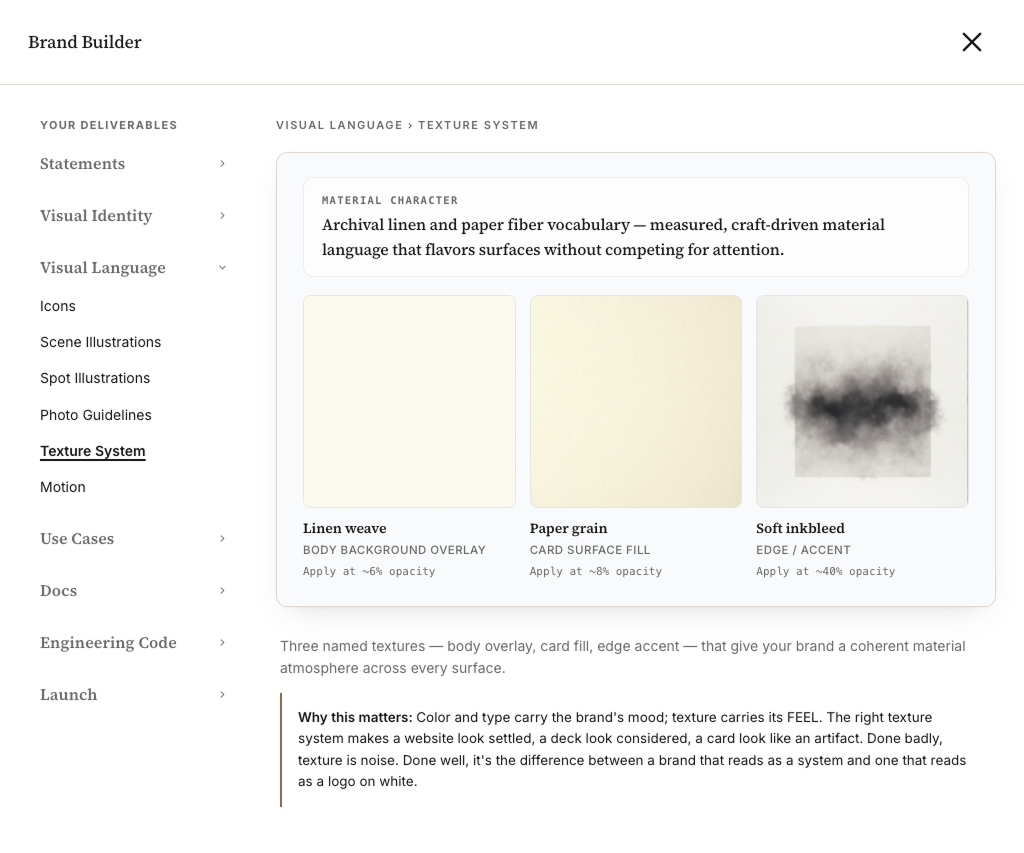
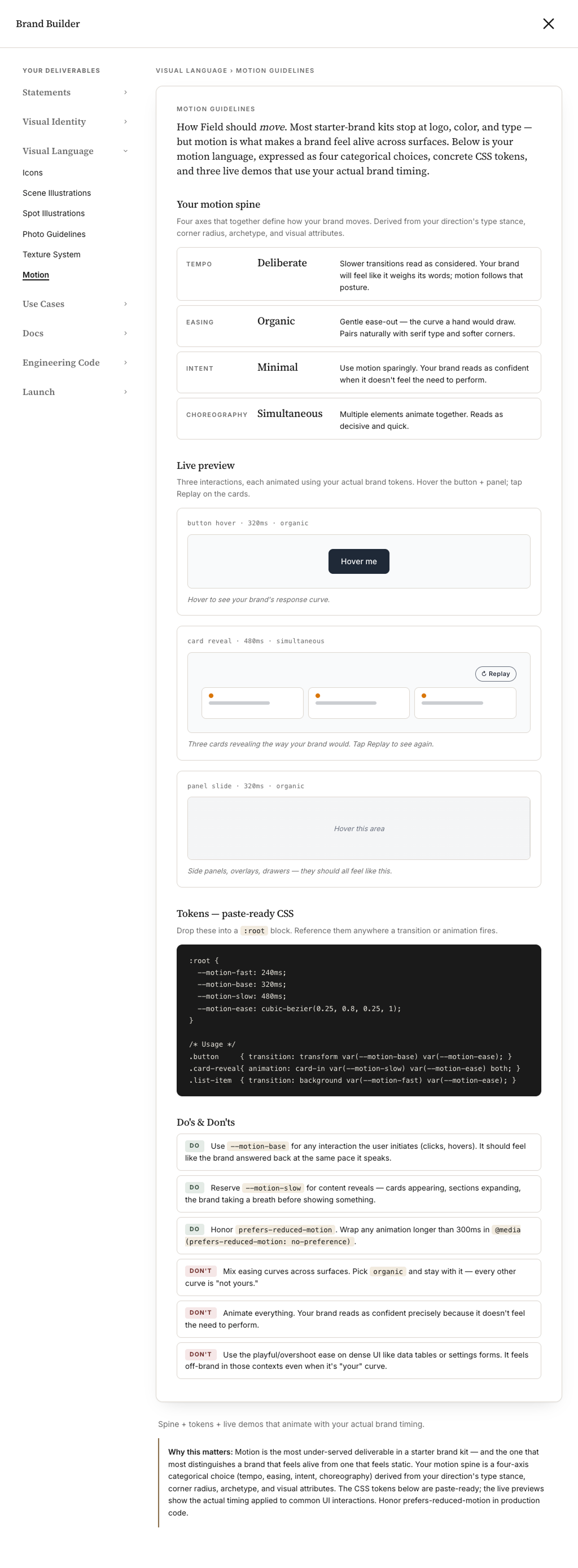
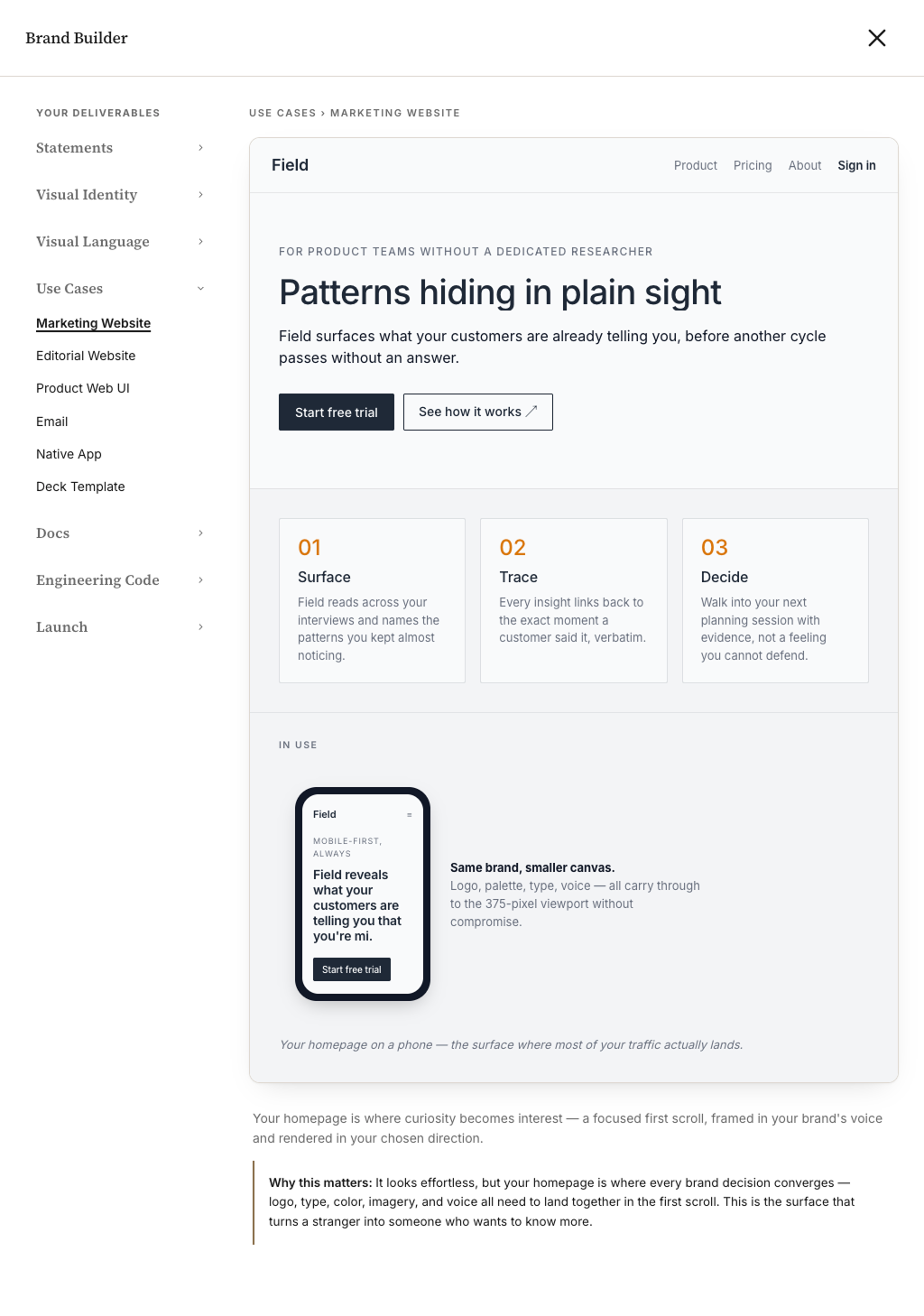
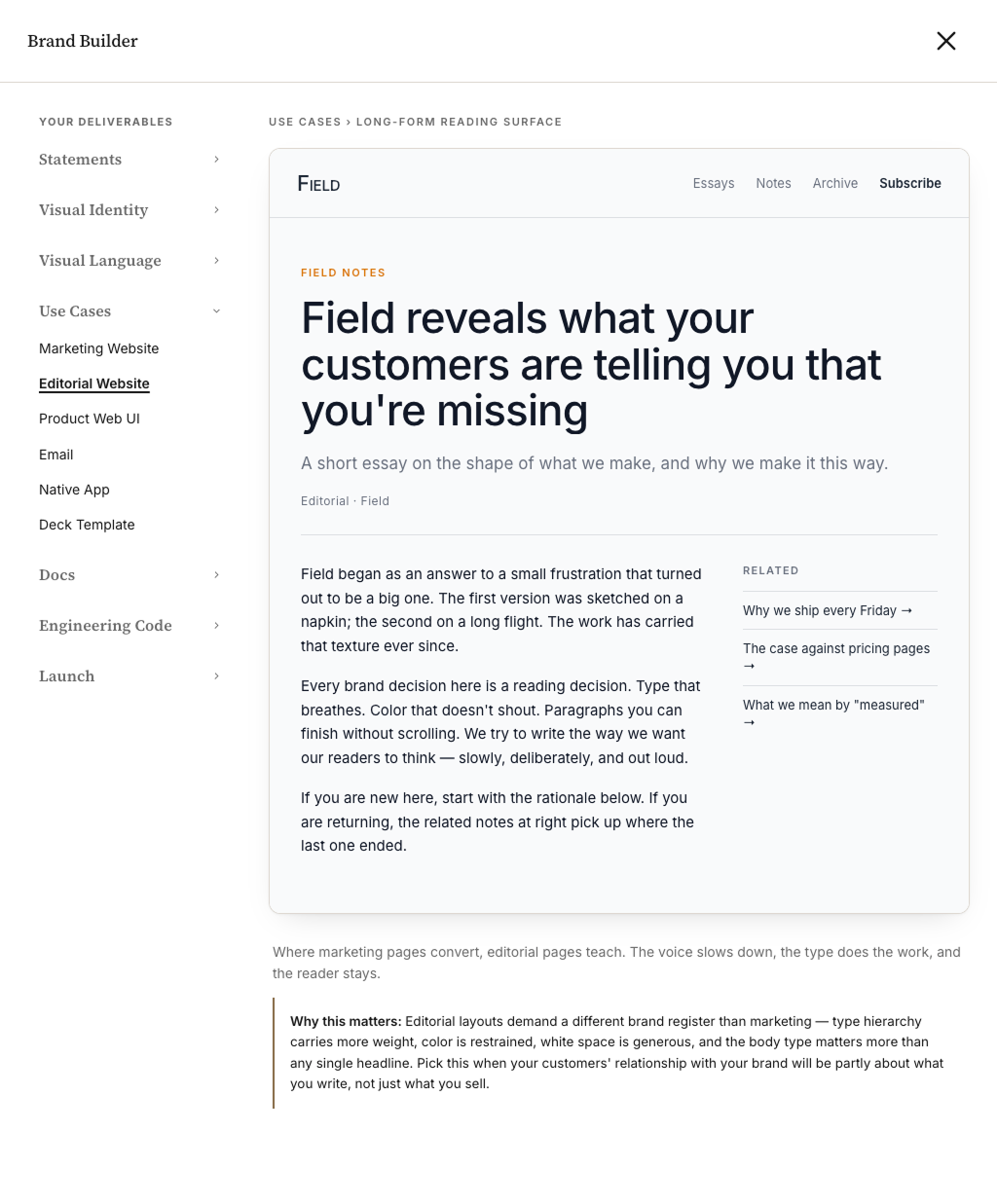
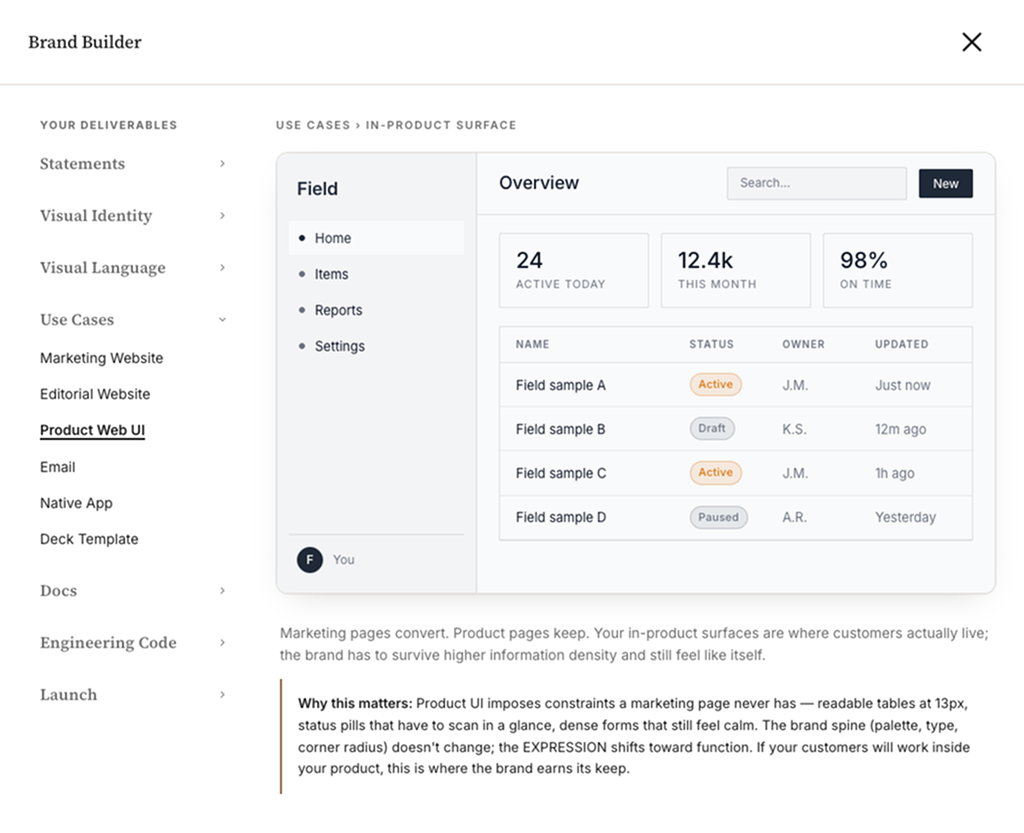
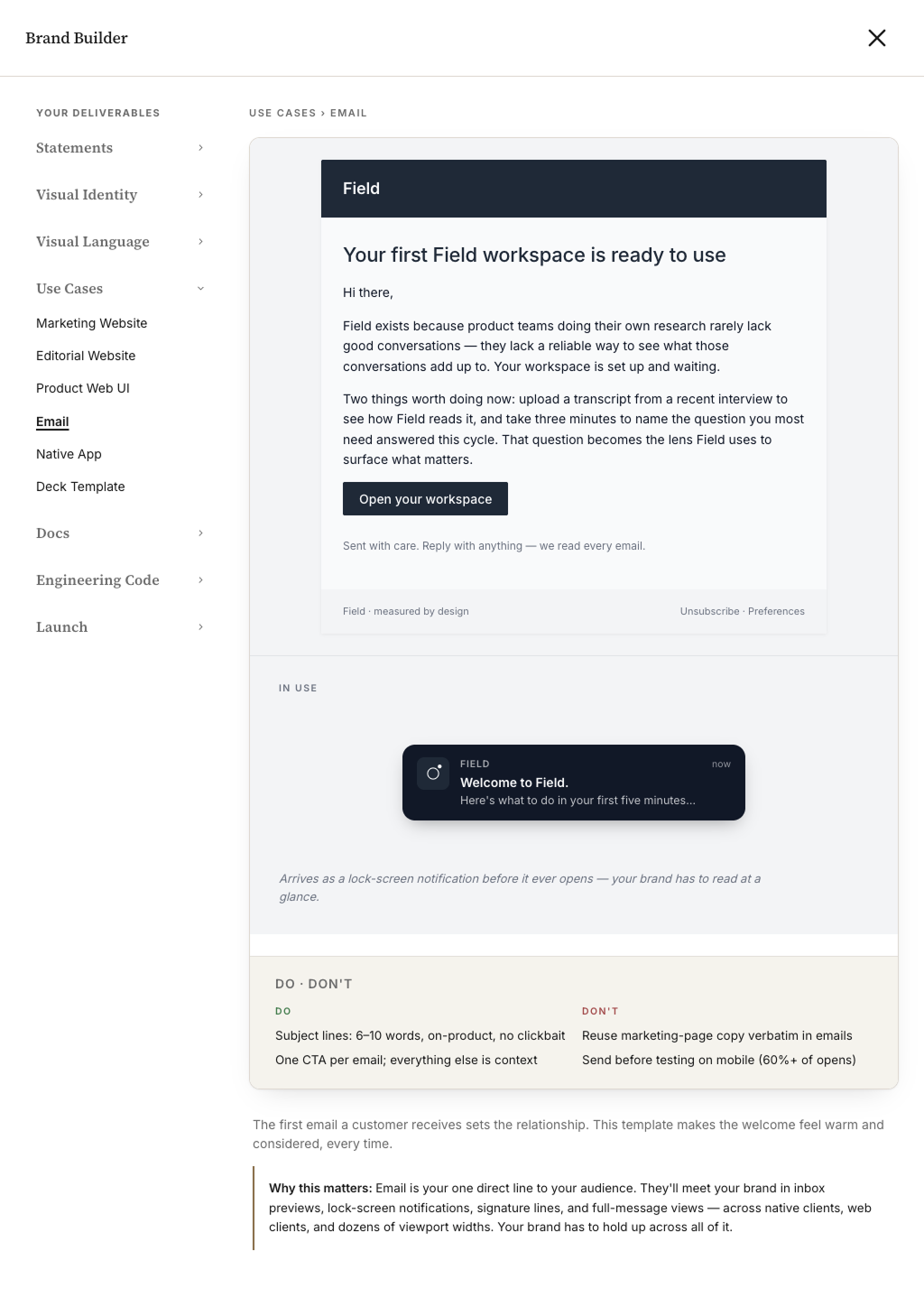
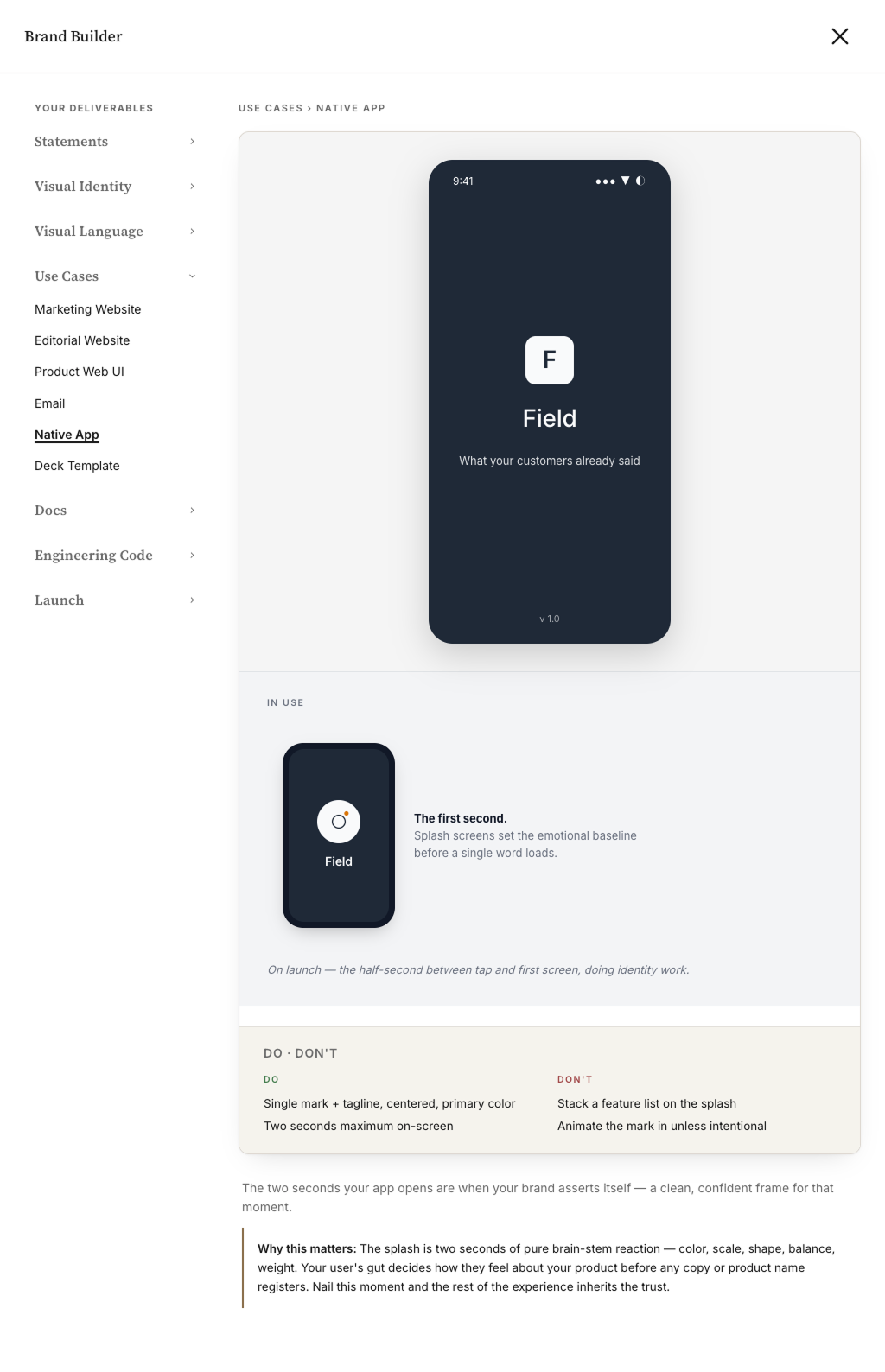
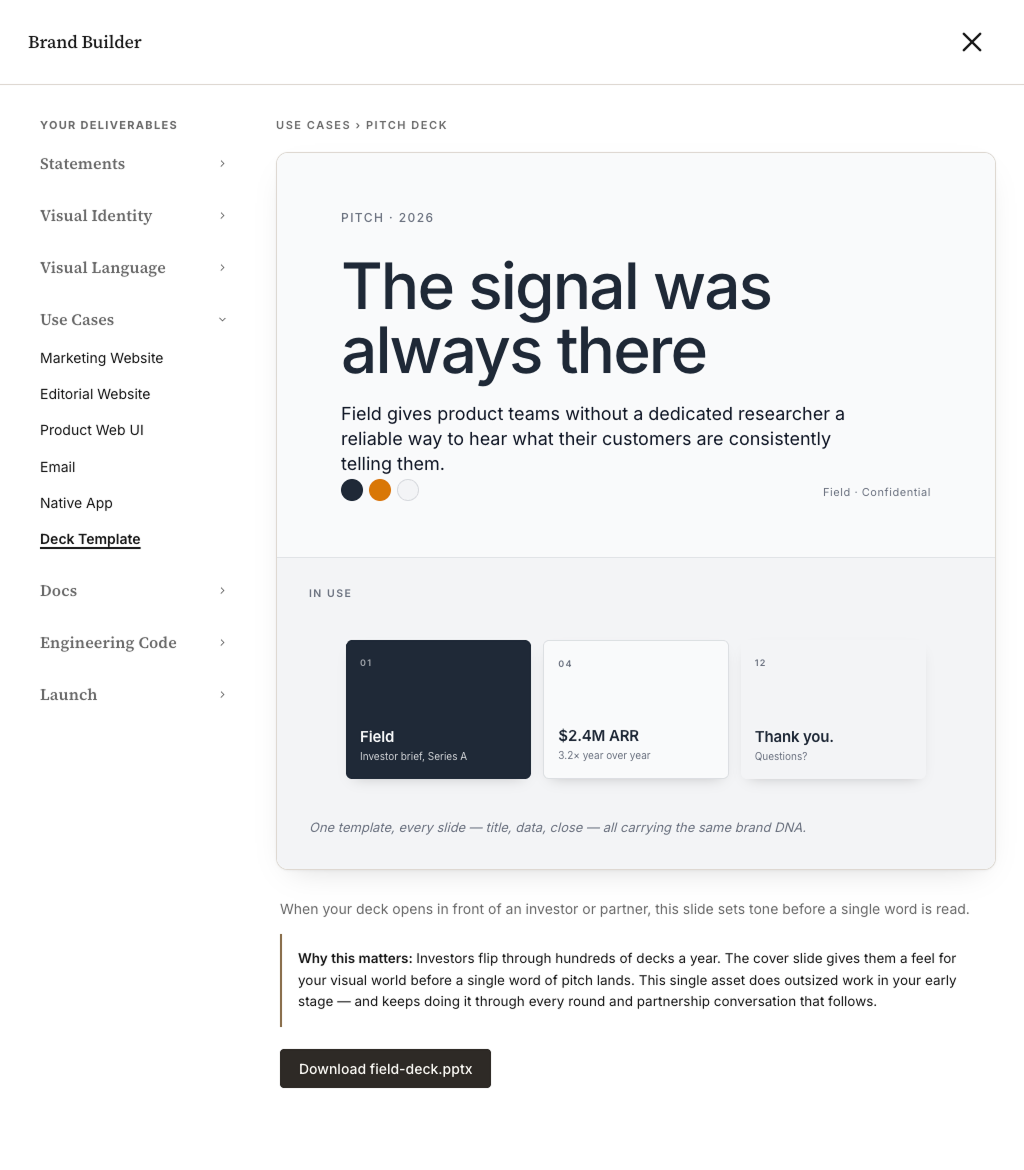
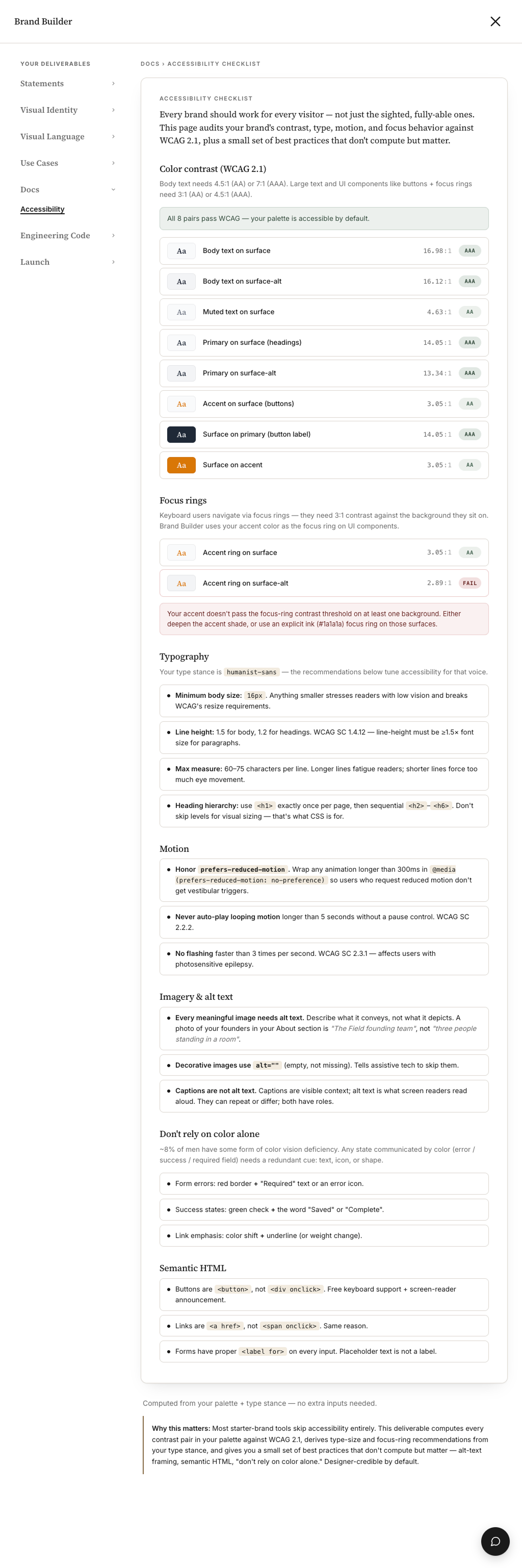
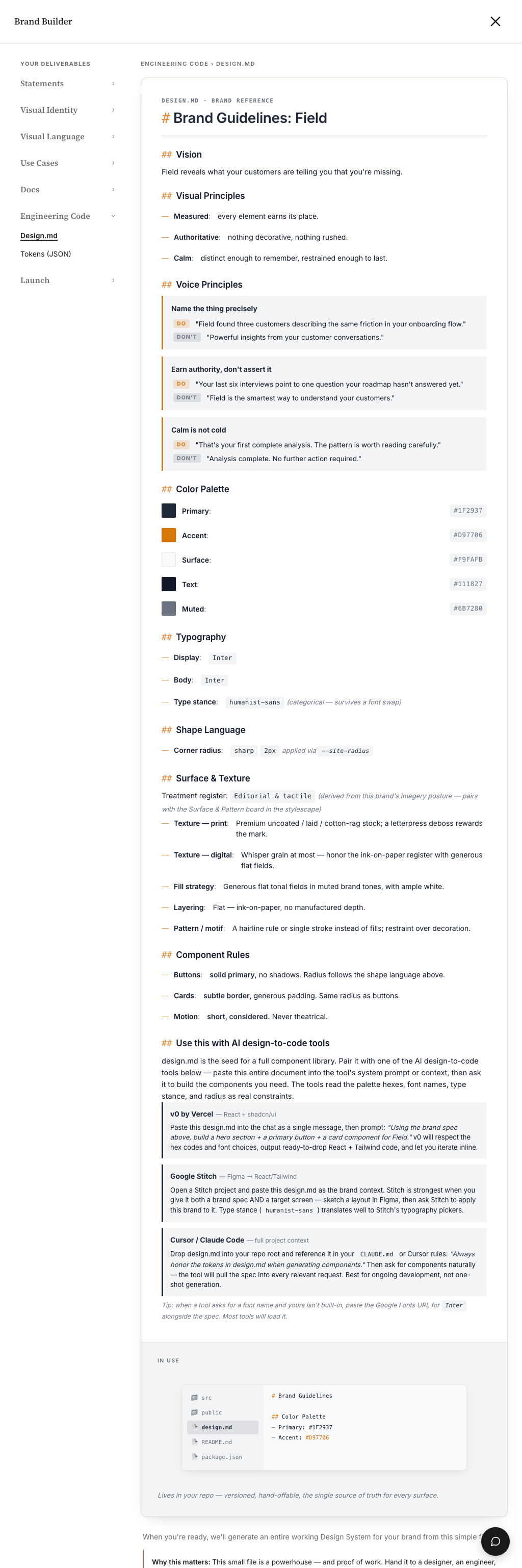
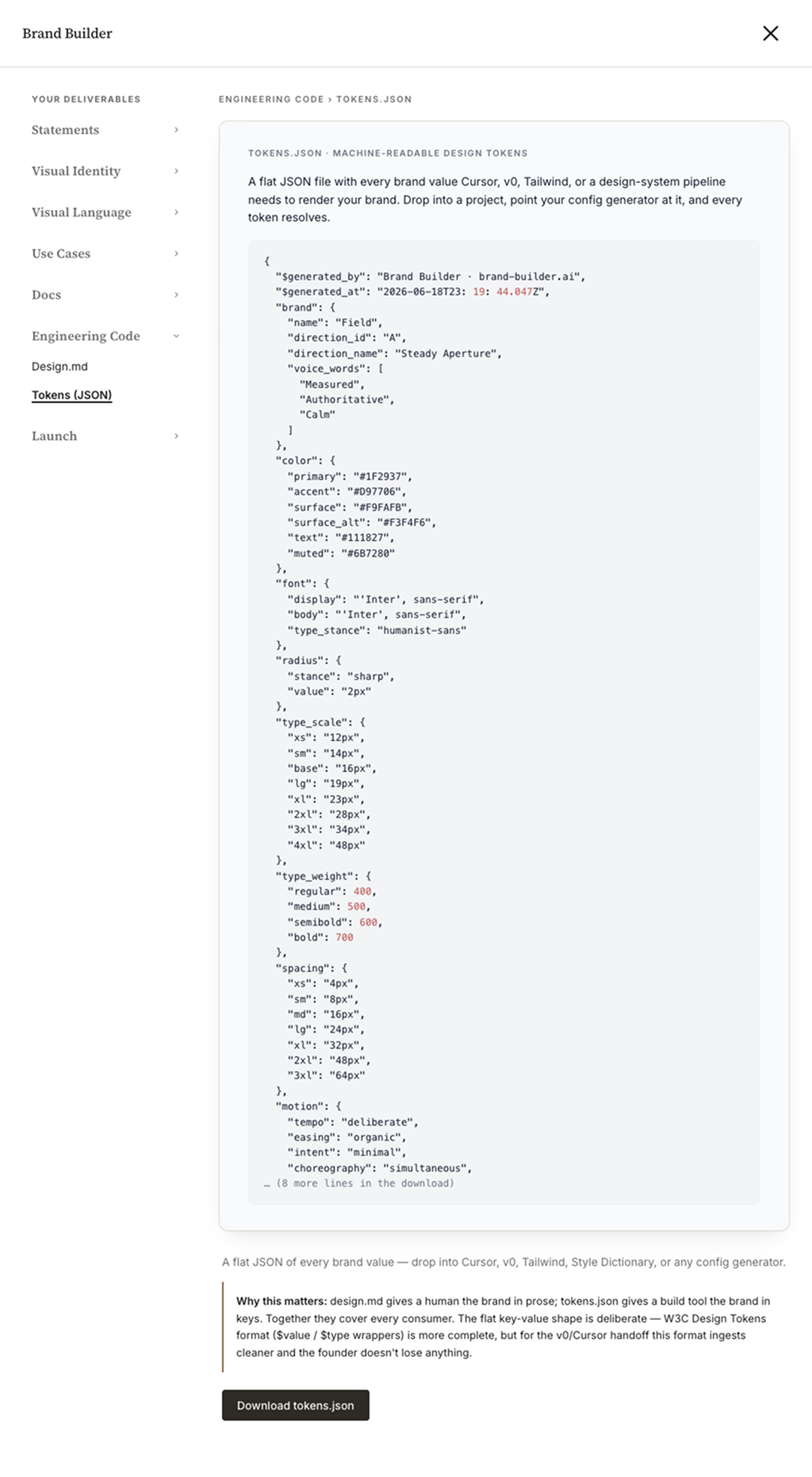
Statements (tagline, brand story, voice + tone). Visual identity (logo, favicon, palette, type). Visual language (icons, scene + spot illustrations, photo guidelines, texture system). Use cases (marketing site, editorial site, product UI, email, splash, deck). Docs (brand foundations, accessibility, motion). Engineering handoff (design.md, tokens.json).
A sticky meter tracks progress — "14 of 17 ready · ~2 min remaining." Shipped-quality artifacts, usable in a pitch deck the next morning.
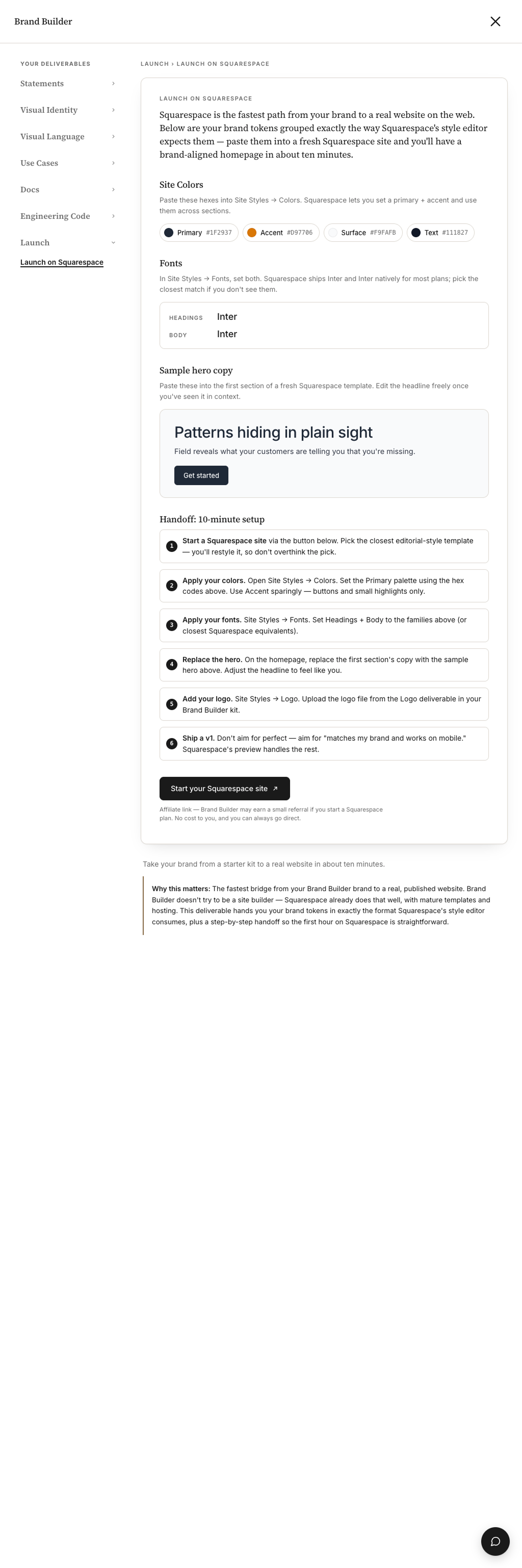
Samples:
4. Next steps
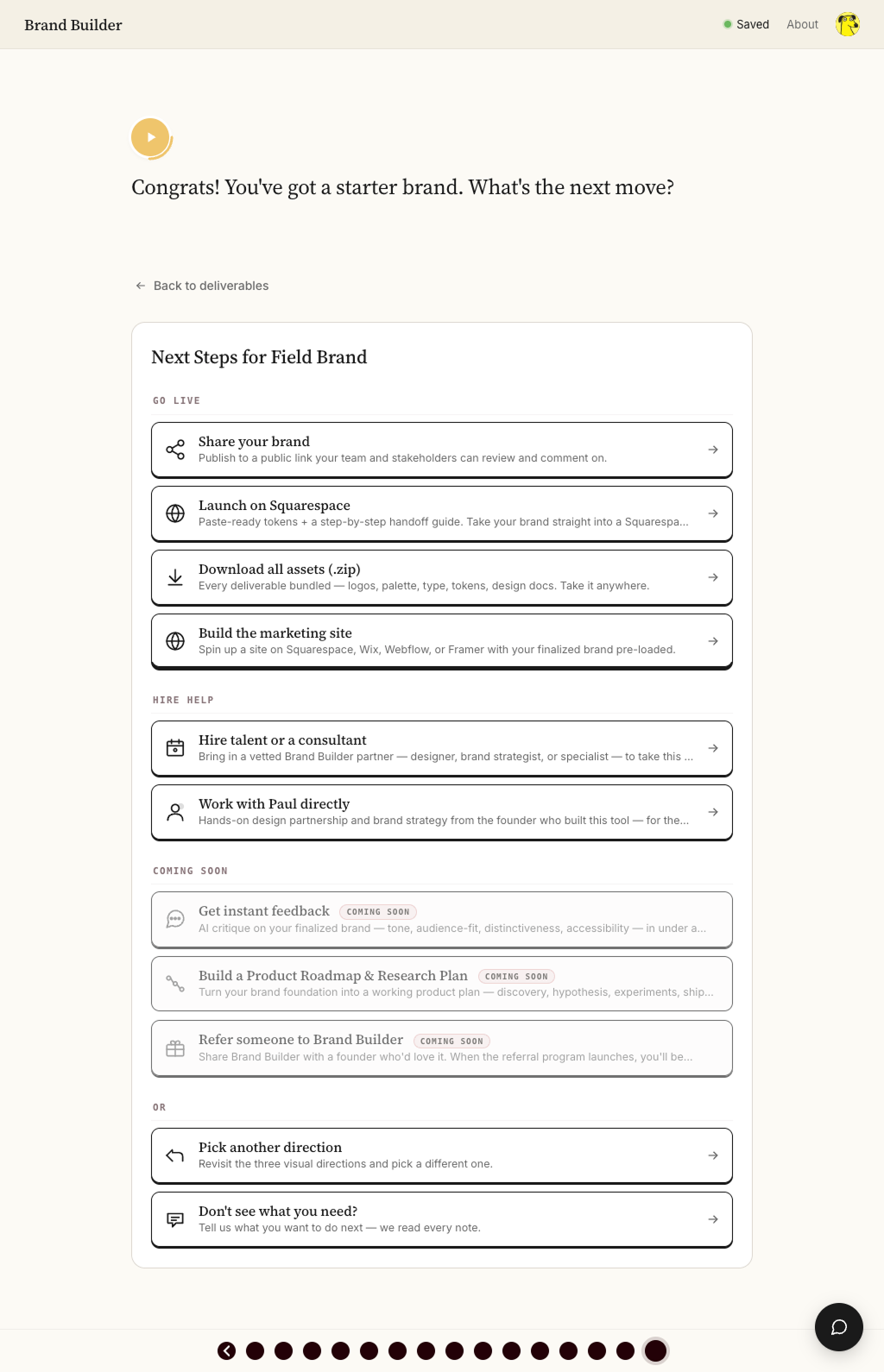
Once deliverables land, the founder chooses their next move:
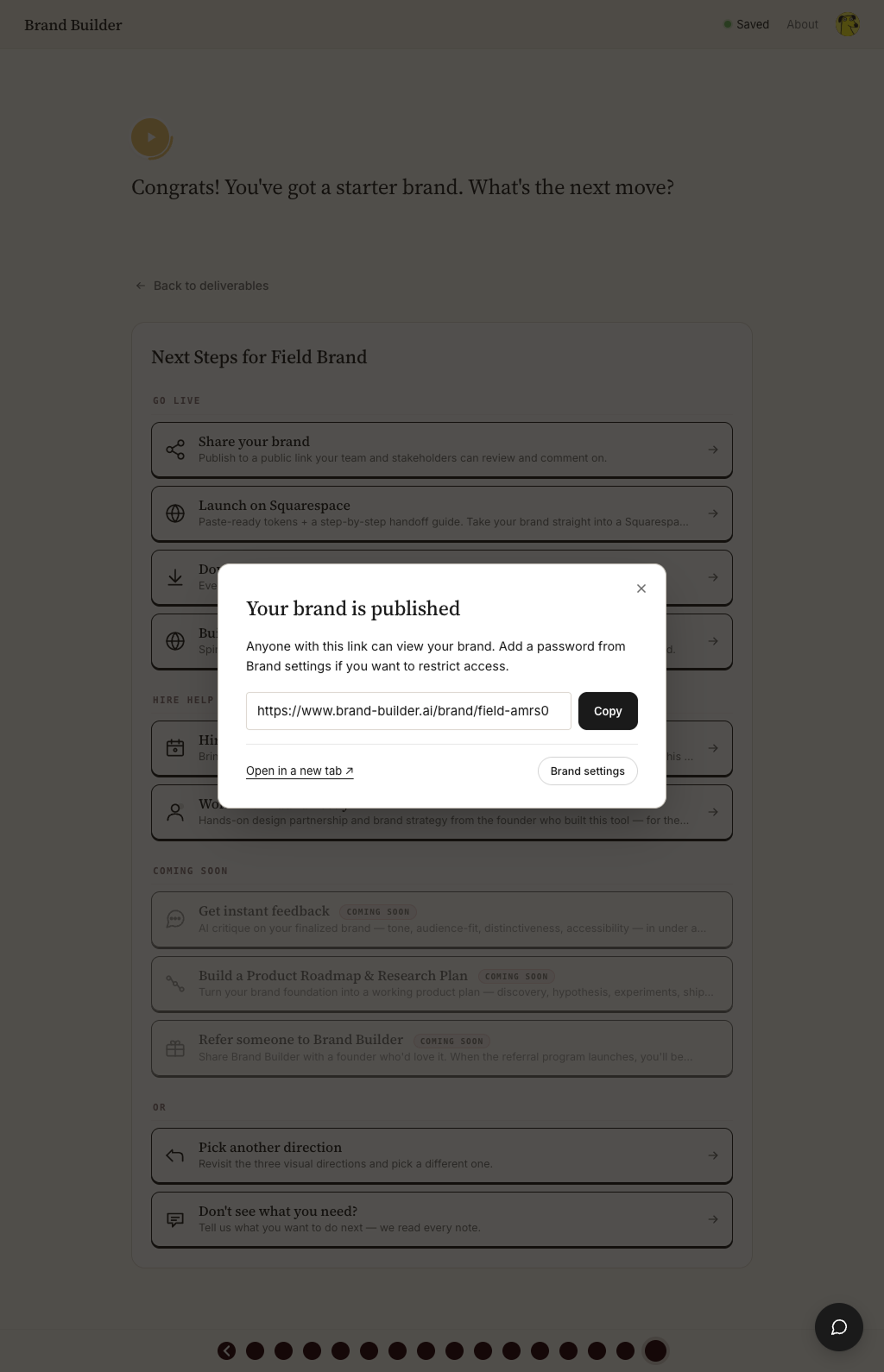
Hosted brand book. Private URL, live document, shareable with cofounders and hires. Not a PDF export.
A consult with me. Paid engagement for teams extending the system to their real product surfaces or pressure-testing the strategy with a human.
Continue building. The tool regenerates any deliverable with new context and evolves as the brand matures.
A path into Aether AI. Private, self-hosted SKILL.md library (including LoRAs for imagery) that every AI tool in the team's stack reads from — brand methodology as a versioned, portable asset.
Under the hood
Multi-model orchestration
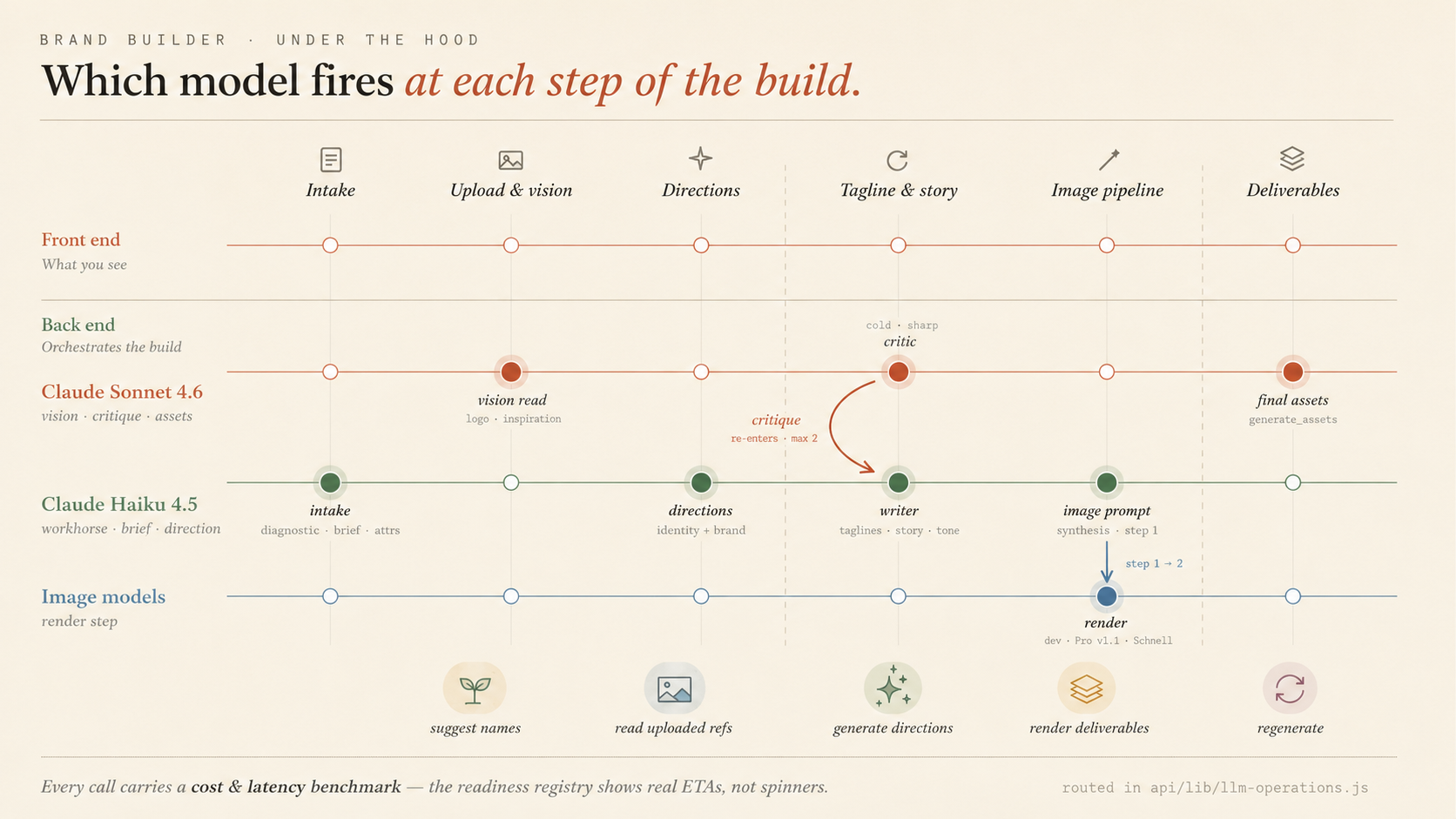
Every model in Brand Builder earns its role by cost, latency, and capability — not by which one is trendy.
Claude Sonnet handles vision analysis of uploaded logo files and inspiration references. That's where reasoning matters most: the vision read needs to be structured and defensible so the founder can correct it inline.
Claude Haiku runs synthesis and structured extraction — palette synthesis from vision output, typography intent from natural-language asks, anti-reference cards, tagline and brand-story critique-improve loops, and the diagnostic extraction from the intake landing. Fast, cheap, factual work.
FLUX Pro 1.1 generates hero imagery, bespoke illustrations, and photo guideline shots — surfaces where visual quality is the whole point.
FLUX schnell handles moodboard textures and content layouts — surfaces where speed matters and stylistic variety pays off.
Every model call carries a cost and latency benchmark that drives the UI's readiness registry. The founder sees ETAs derived from real per-call budgets, not hand-wavy loading spinners. The system continuously improves as new LLM-models come on the market.
Prompt engineering as a design system
Traditional prompt engineering lives in opaque inline strings. Brand Builder factors it into a modular library of 15+ SKILL.md files — one per domain of design craft. For example:
typography-systems teaches Claude the taxonomy of type stances and how each one holds up across surfaces.
mark-semantic-grammar carries the vocabulary of how marks signal meaning.
color-system-across-surfaces enforces that a palette must be judged as a system applied to real surfaces — website, native app, email, print — not in the abstract. accessibility runs computed contrast checks on every generated combination.
Each skill is versioned, reviewable markdown. When a generation task fires — a logo brief, a photo guideline, a brand voice synthesis — the relevant skills load into Claude's prompt context. Generating any deliverable isn't a single prompt; it's a composition of methodologies applied to a specific founder context.
The result: better outputs from cheaper models, and a portfolio of design knowledge that compounds every time I write a new skill.
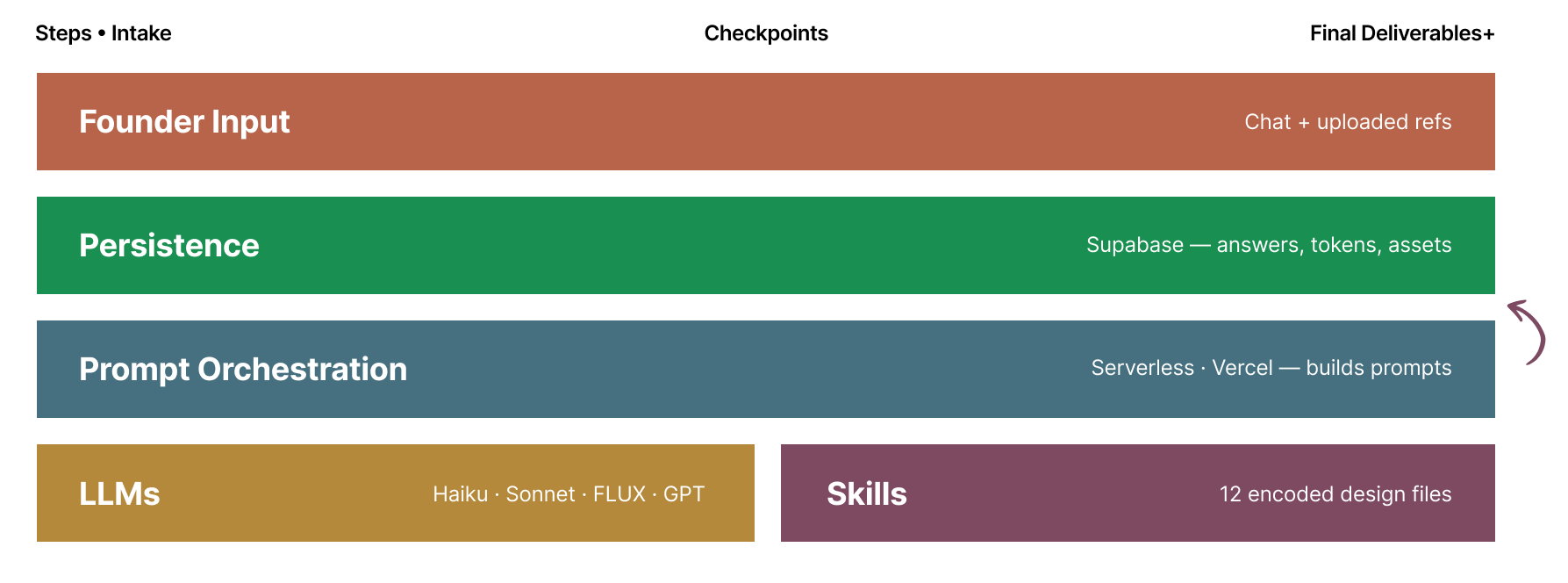
Architecture: encoded skills files and multiple LLMs for a single prompt.
Human-in-the-loop feedback
Every generated tile — a hero image, a bespoke illustration, a texture, a content layout — carries an inline retry composer. The founder types specific feedback ("warmer lighting, less studio feel" / "looser line work, more hand-drawn") and their words flow back into the same prompt builder that produced the original tile.
The regeneration prompt reads the founder's feedback as an authoritative override — the founder's classification wins on conflict. It's the same cascade pattern that governs the logo-upload flow: one paragraph the founder typed becomes the override layer in every downstream consumer.
This turns regeneration into a first-class design surface, not an escape hatch. It also gives the founder a language to talk about their own brand — because the words they type to correct a tile are the same words that describe their brand voice.
A per-tile retry cap (4) prevents runaway. A "Regenerating with your feedback…" caption replaces the retry pill during the call so the founder sees their words were captured.
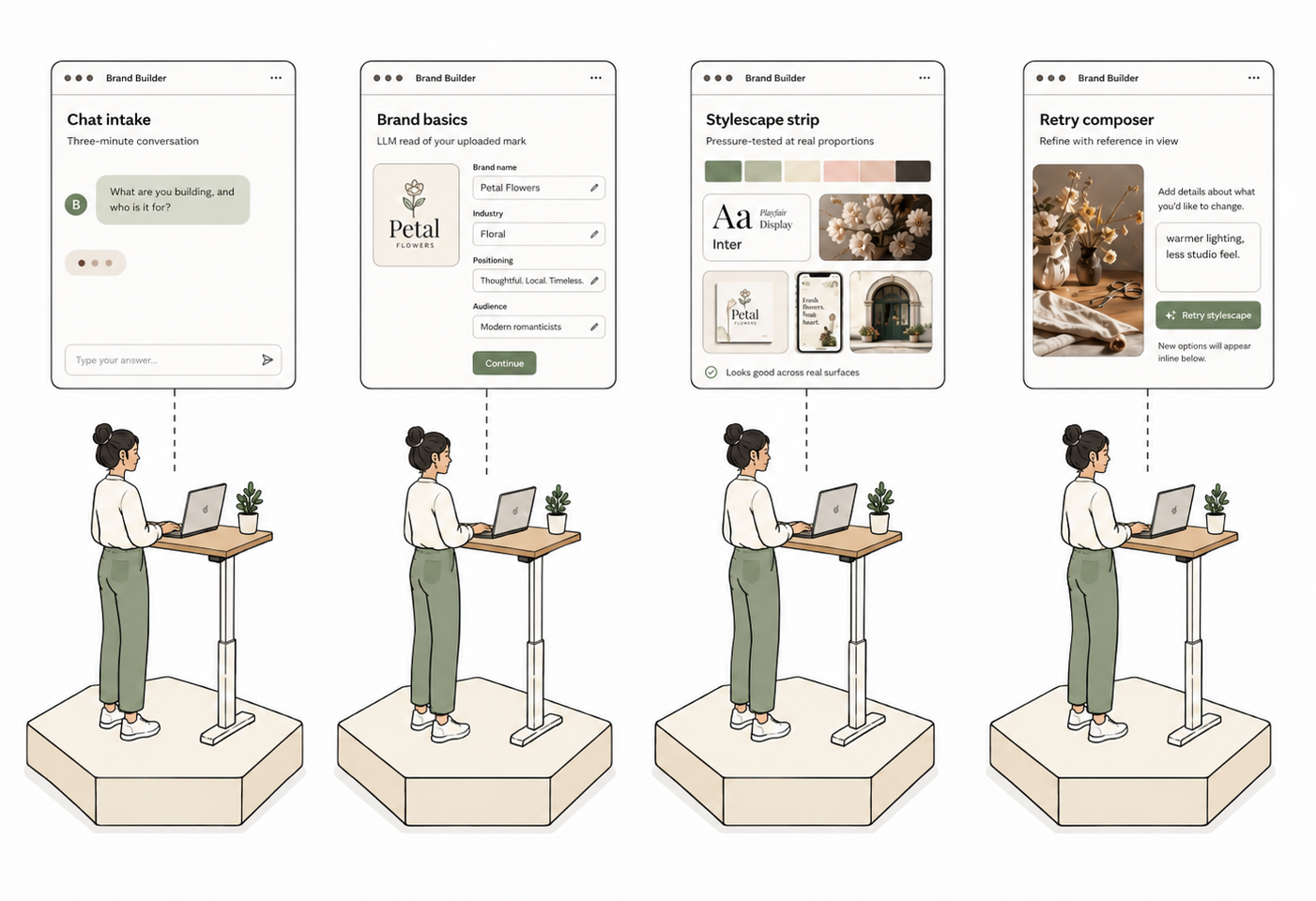
Iteration: each generated asset includes a retry composer to dial creative details.
What comes after generation
Brand Builder produces a complete brand foundation in the browser. What happens next is where the tool becomes a durable asset instead of a beautiful one-shot:
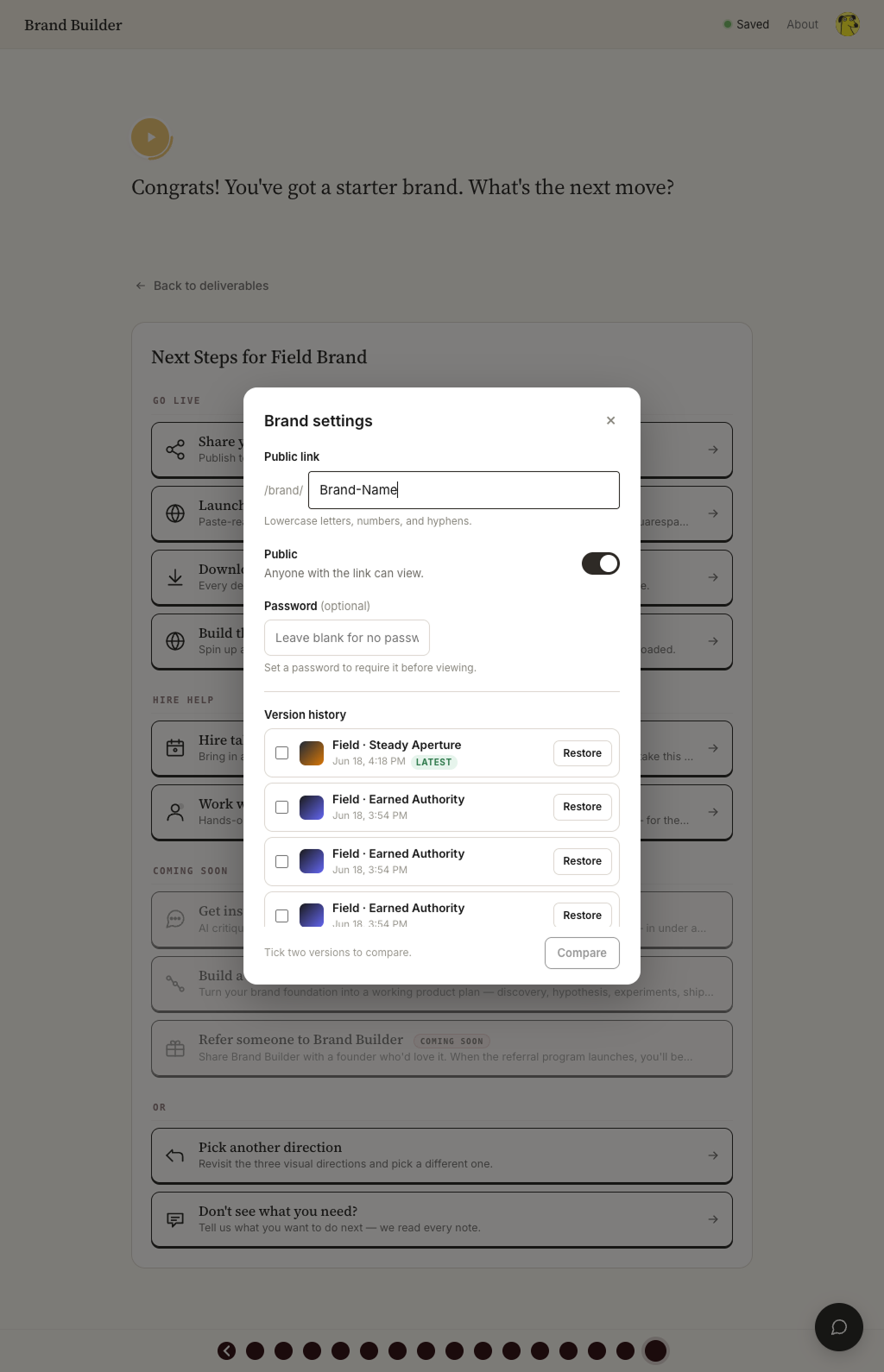
A hosted, password-protected brand book. Every founder walks away with a private URL — a live document they can share with a cofounder, an early hire, or an agency they're briefing. It's not a static PDF export; it's the same skill-composed document Brand Builder used to generate the brand in the first place, updated in place as the brand evolves. The whole team reads the same source of truth.
A meaningful consult. For teams that want to go deeper — extending the system to their real product surfaces, integrating with existing marketing, or pressure-testing the strategic frame with a human — I offer a paid engagement. Founders who take that path leave having saved time, saved money, and learned something durable about how brand rigor translates to product decisions. The tool is a starting point; the consult is where the design work compounds.
Stack + build
Single-file HTML/CSS/JS front end (no framework). Vercel serverless (Node.js) for the API layer. Supabase for auth, Postgres, and object storage. fal.ai for FLUX image generation. Anthropic for Claude reasoning and synthesis.
Solo build. Four months of evenings and weekends. Product design, visual design, prompt engineering, backend, deploy pipeline — all one person.
Want the deeper thinking?
Read my essay: A Skills System, Not a Prompt Library — What Building Brand Builder Solo Taught Me About the Next Shape of Design Work
The Bigger Idea
Aether AI — the bigger idea. Brand Builder is one expression of a broader thesis I'm building toward at Aether AI: a company's methodology — its brand, its voice, its component patterns, its accessibility standards — becomes a versioned library of SKILL.md files that lives on a self-hosted server, private to the business, and every AI tool that team uses reads from it as the single source of truth. Not cloud-shared. Not vendor-locked. The methodology becomes a durable, portable asset — and the design work compounds beyond any one tool.
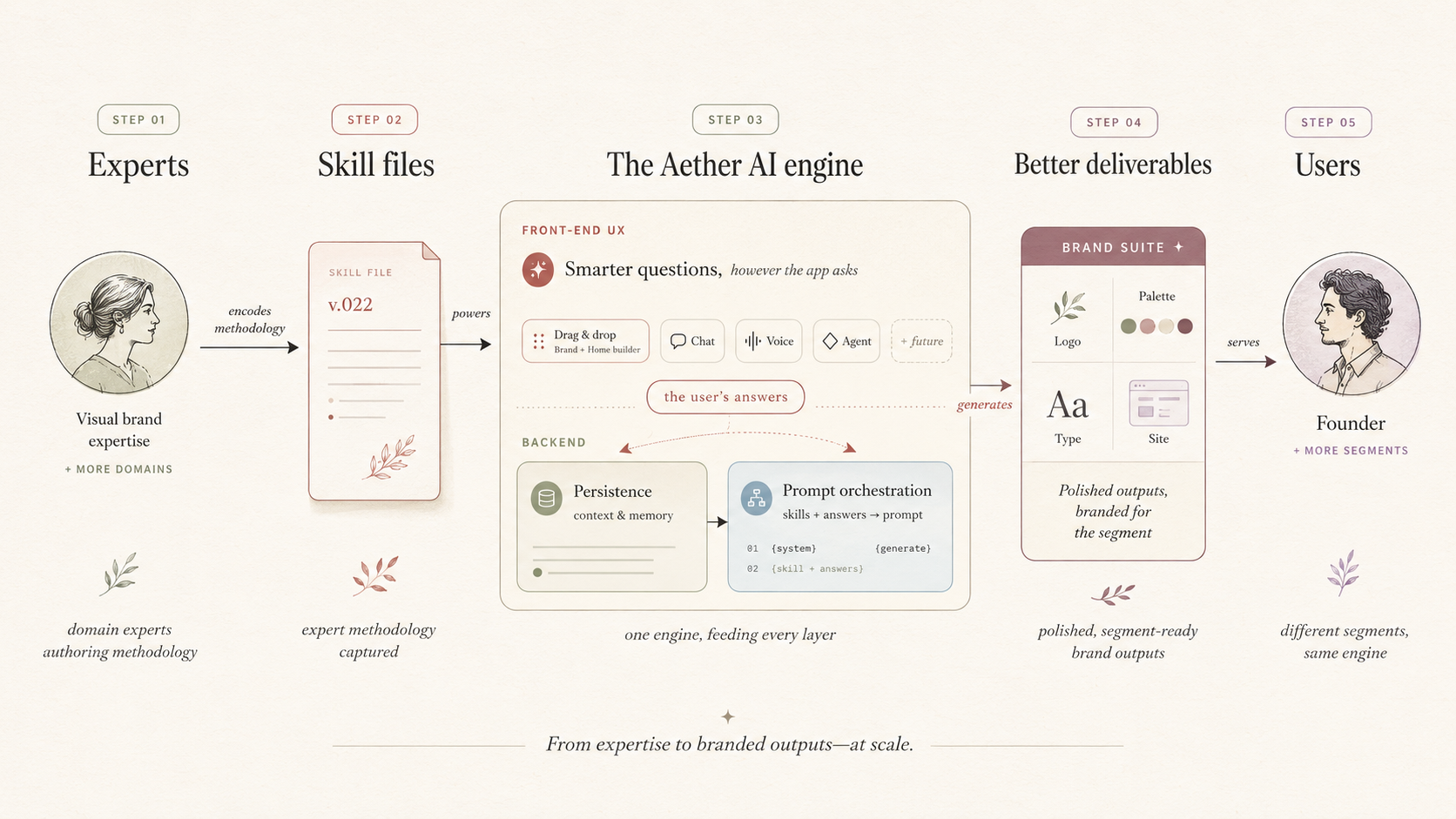
brand-builder.ai is one key example of the skills experience engine I’ve created, called AetherAI. This architecture model continues to work for new use expert and industry use cases. Interested in more – message me.